

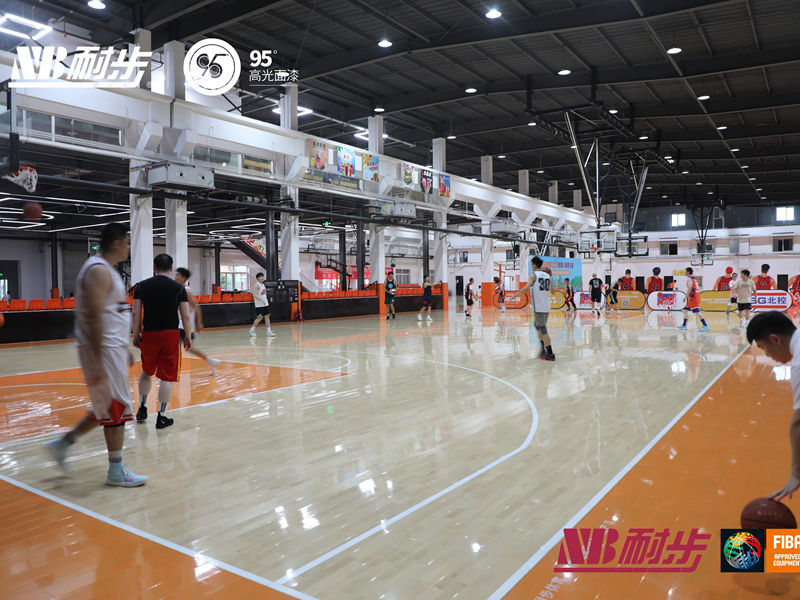
If you have ever watched a professional basketball game on television, you have almost certainly seen maple hardwood flooring. From the NBA to the NCAA, maple is the undisputed king of indoor basketball court surfaces. But why maple? What makes this particular species so dominant in a sport that demands so much from its playing surface?
The answer lies in a combination of physical properties, visual characteristics, and historical precedent. Let us start with the physical side. Hard maple, specifically sugar maple, has a Janka hardness rating of approximately 1,450 pounds. The Janka rating measures the force required to embed a steel ball halfway into the wood. For context, red oak is around 1,290, and white oak is about 1,360. This means maple is significantly harder than many other common hardwood species, giving it superior resistance to dents, scratches, and gouges.
But hardness alone does not explain maple's dominance. Grain structure matters just as much. Maple has a very tight, uniform grain. This means there are fewer weak points where the wood can split or splinter under stress. When a player plants their foot and makes a sharp cut, the floor must resist the lateral force without tearing. Maple's tight grain handles this exceptionally well.
The color of maple is another reason for its popularity. Maple is naturally light, ranging from creamy white to pale yellow. This light color provides excellent contrast with the orange basketball, making it easier for players, referees, and spectators to track the ball. In darker wood floors, the ball can sometimes blend into the background, especially under certain lighting conditions. The light color also makes the court look clean and professional, which matters for television broadcasts and facility image.
Historical factors have also cemented maple's status. The Boston Garden, one of the most iconic basketball venues in history, installed a maple floor in the 1950s. When the NBA was forming its modern identity in the 1960s and 1970s, maple was already the standard in the best arenas. As the league grew, new arenas copied the look and feel of the established ones. By the time arena construction accelerated in the 1990s and 2000s, maple was simply the default choice.
There is also a practical reason related to finish. Maple takes finish very well. The clear coats applied to basketball court floors need to be hard, durable, and resistant to scuffing. Maple accepts these finishes evenly, creating a smooth, consistent surface. Other species may have more variation in how they absorb finish, leading to uneven sheen or premature wear in certain areas.
That said, maple is not without its drawbacks. It is more expensive than many alternative species. It can be more susceptible to moisture damage if not properly sealed. And in very high-humidity environments, maple can cup or bow if the subfloor is not adequately engineered. These issues are manageable with proper installation and maintenance, but they are worth noting.
Alternatives like oak and birch exist, and they have their own merits. Oak is harder and more moisture-resistant. Birch is less expensive and still provides good performance. But for the combination of hardness, grain consistency, color, and finish quality, maple remains the gold standard.
In the end, maple dominates indoor basketball court flooring because it delivers the complete package. It is tough enough to handle the most athletic players in the world, beautiful enough for prime-time television, and proven enough that no facility manager wants to be the one to deviate from the standard.
Leave a Reply