

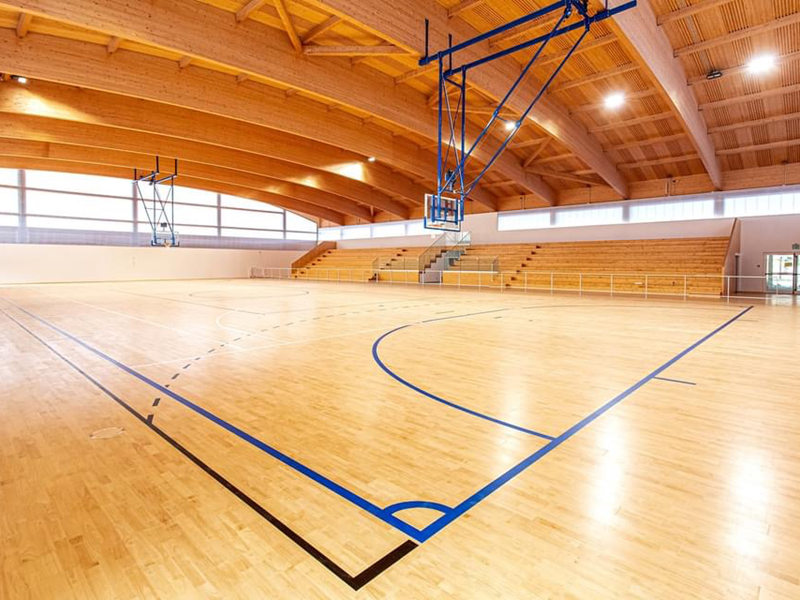
When it comes to indoor basketball, the floor beneath your feet matters more than most players realize. The hardwood surface is not just a background element. It is the foundation of every dribble, every pivot, every jump shot, and every slam dunk. Choosing the right hardwood flooring for an indoor basketball court is one of the most consequential decisions a facility manager, school administrator, or sports complex owner will ever make.
Hardwood flooring for indoor basketball courts is engineered differently from the wood you might find in a living room or office. It must withstand extreme forces. A professional basketball player can generate vertical forces exceeding five times their body weight when landing from a dunk. That means a 200-pound player can momentarily exert over 1,000 pounds of force on a single square foot of flooring. The wood must absorb that impact without cracking, warping, or losing its structural integrity.
The most commonly used species for indoor basketball court hardwood include maple, oak, and birch. Maple is by far the most popular choice in professional and collegiate settings. Its tight grain structure provides excellent durability, and its light color creates a clean, high-visibility playing surface that players and referees prefer. Oak is harder and more resistant to denting, making it a solid choice for high-traffic recreational facilities. Birch offers a middle ground, with good hardness and a warm appearance.
Beyond the species, the construction of the floor matters enormously. Most indoor basketball court hardwood systems consist of multiple layers. The top layer is the actual hardwood, typically between 20 and 26 millimeters thick. Beneath that lies a subfloor, often made of plywood or oriented strand board, which provides dimensional stability. Below the subfloor, you may find additional layers of cushioning, vapor barriers, and concrete slabs, depending on the building structure.
One of the most critical components of any indoor basketball court hardwood system is the shock absorption layer. This is usually a foam or rubber pad installed between the subfloor and the hardwood. The thickness and density of this pad determine how much impact the floor absorbs. Too little shock absorption, and players risk joint injuries. Too much, and the floor feels mushy, which affects ball bounce and player agility. The standard for professional courts calls for a vertical shock absorption rate between 35 and 53 percent, meaning the floor should return 35 to 53 percent of the force applied to it.
Ball bounce is another performance metric that defines a quality basketball court hardwood floor. The ball bounce should be consistent and predictable across the entire surface. A good hardwood floor will return the ball to a height between 49 and 54 inches when dropped from 72 inches. This consistency is essential for fair play and for players to develop muscle memory.
Maintenance is an ongoing responsibility. Indoor basketball court hardwood requires regular sweeping to remove dust and debris that can act as abrasives. Mopping should be done with a damp mop, never a wet one, because excessive moisture is the enemy of hardwood. Over time, the finish on the surface will wear down and need to be recoated. This is typically done every three to five years in high-use facilities. Sanding and refinishing can extend the life of the floor by decades.
Cost is always a factor. A fully installed indoor basketball court hardwood system, including subfloor, shock absorption, and finishing, can range from ten to twenty dollars per square foot or more, depending on the species, thickness, and regional labor costs. While this is a significant investment, a well-maintained hardwood floor can last twenty-five to forty years, making it one of the most cost-effective long-term flooring solutions available.
In summary, indoor basketball court hardwood flooring is a sophisticated, multi-layered system designed to perform under extreme physical demands. It requires careful selection of species, proper installation, and diligent maintenance. When done right, it provides the safest, most consistent, and most professional playing surface available for the game of basketball.
Leave a Reply