

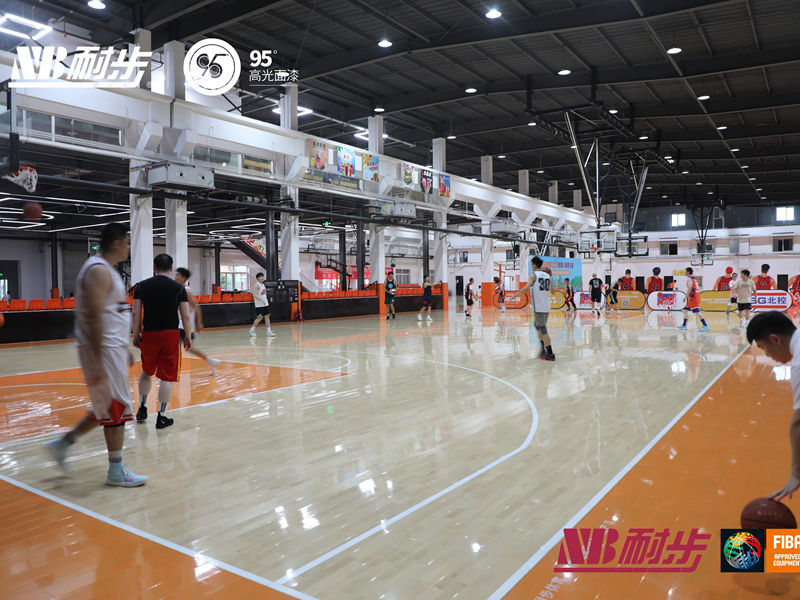
For over a century, hardwood has been the surface of choice for indoor basketball. From high school gymnasiums to professional arenas, the sound of sneakers squeaking on polished wood has become synonymous with the sport itself. But why does hardwood remain dominant in an era of advanced synthetic materials? The answer lies in a combination of physics, biomechanics, and player experience that synthetic alternatives have struggled to match.
The Physics of Ball Bounce on Hardwood
One of the most critical performance metrics for any basketball court surface is ball bounce consistency. Players at every level rely on a predictable bounce to develop their dribbling skills, shoot with accuracy, and react quickly during gameplay. Hardwood provides a ball bounce that is remarkably consistent across the entire surface. The energy return from a hardwood floor typically ranges between 90 and 96 percent, meaning that when a ball hits the floor, it returns nearly all of its kinetic energy. This high energy return is what gives hardwood its characteristic "lively" feel.
Synthetic surfaces, by contrast, tend to absorb more energy, resulting in a deader bounce. While some modern synthetic floors have improved their energy return, they still generally fall short of hardwood. More importantly, synthetic surfaces can exhibit inconsistent bounce patterns due to temperature fluctuations, wear patterns, and manufacturing variations.
Traction and Player Safety
Traction is another area where hardwood excels. The surface of a properly finished hardwood court provides just the right amount of grip — enough to allow players to stop, cut, and change direction quickly, but not so much that it causes excessive stress on joints. The coefficient of friction on a well-maintained hardwood court falls within an optimal range that reduces the risk of slipping while also minimizing the risk of traction-related injuries such as ankle sprains and knee ligament tears.
Synthetic surfaces can be either too slippery or too grippy, depending on the material and finish. Some players report that synthetic courts feel "sticky," which can increase the torque on the knee during lateral movements, potentially raising the risk of ACL injuries. Hardwood, with its natural texture and finished surface, offers a more balanced traction profile that has been refined over decades of use.
Shock Absorption and Injury Prevention
Basketball is a high-impact sport. Players jump, land, and change direction hundreds of times per game, placing enormous stress on their joints, particularly the knees, ankles, and lower back. The shock absorption properties of the floor play a direct role in injury prevention.
Hardwood, when installed over a properly engineered subfloor with adequate cushioning, provides excellent shock absorption. The combination of the wood itself, the finish, and the underlying subfloor system works together to reduce the impact forces transmitted to the player's body. Studies have shown that players on hardwood courts experience lower rates of certain joint injuries compared to players on harder surfaces like concrete or less resilient synthetic floors.
Aesthetics and Tradition
Beyond performance, hardwood carries an aesthetic and cultural significance that synthetic surfaces cannot replicate. The warm tone of polished maple, the clean lines of the court markings, and the overall ambiance of a hardwood court create an atmosphere that players and spectators associate with the sport at its best. This psychological factor, while often overlooked, contributes to the overall experience of playing and watching basketball.
The Verdict
Hardwood remains the gold standard not because of tradition alone, but because it delivers a combination of performance, safety, and experience that no other surface has been able to fully replicate. As long as basketball is played at competitive levels, hardwood will remain the floor of choice.
Leave a Reply