

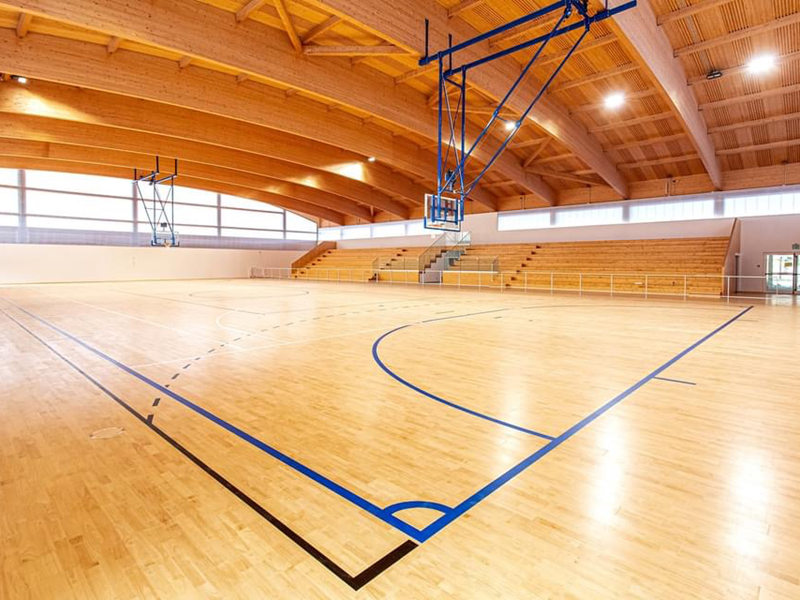
When it comes to indoor basketball court flooring, hardwood remains the gold standard. Whether you are a facility manager, a school administrator, or a private court owner, understanding the full lifecycle of hardwood flooring — from material selection to daily maintenance — is essential for protecting your investment and ensuring player safety.
Why Hardwood Dominates Indoor Basketball Courts
Hardwood flooring has been the preferred surface for professional and competitive basketball since the sport's earliest days in gymnasiums. The reason is simple: hardwood offers a unique combination of shock absorption, ball bounce consistency, and player traction that no synthetic surface has been able to fully replicate. When a player dribbles a basketball on a properly installed hardwood court, the ball returns to their hand with a predictable and consistent bounce. This predictability is critical for skill development, especially for young players who are still learning the fundamentals.
The most commonly used species for indoor basketball courts are hard maple and white oak. Hard maple, particularly sugar maple and black maple, is the industry favorite because of its density, uniformity, and light color, which provides excellent visibility under gymnasium lighting. White oak is also used, especially in facilities where durability and resistance to moisture are higher priorities.
Understanding Wood Grades and Select Grades
Not all hardwood is created equal. The National Wood Flooring Association (NWFA) establishes grading standards that categorize hardwood into several grades based on appearance, including the amount of natural character such as mineral streaks, knots, and color variation. For basketball courts, Select and Better grades are typically used. Select grade allows for some natural character while maintaining a clean, consistent appearance. Better grade permits more variation but is still suitable for athletic use. The highest grade, First and Second, is generally reserved for residential settings where appearance is the primary concern and is rarely used in athletic facilities due to cost.
The Installation Process: A Step-by-Step Overview
Installing hardwood on a basketball court is a multi-phase process that requires precision and expertise. The process begins with the subfloor, which is typically plywood or oriented strand board (OSB) laid over a concrete slab. The subfloor must be flat, level, and structurally sound. Any deviations greater than 3/16 inch over 10 feet can cause the finished floor to feel uneven and can lead to premature wear or damage.
Once the subfloor is prepared, a moisture barrier is installed to protect the wood from ground moisture. Then, the hardwood planks are laid using either a nail-down, glue-down, or floating method. The nail-down method is the most traditional and involves driving nails through the tongue of each plank into the subfloor at a 45-degree angle. This method provides the most secure attachment and is preferred for courts that will see heavy use. The glue-down method uses adhesive to bond the planks directly to the subfloor, offering a very stable surface but making future repairs more difficult. The floating method allows the entire floor to move slightly as a single unit, which can help with seasonal expansion and contraction, but it is less common in high-performance basketball settings.
After installation, the floor is sanded in multiple passes, progressing from coarse grit to fine grit. The surface is then sealed with a high-performance polyurethane finish designed specifically for athletic floors. This finish must be thin enough to allow the wood to breathe but tough enough to withstand constant foot traffic, ball impacts, and cleaning. Typically, three to five coats are applied, with light sanding between each coat.
Maintenance: The Key to Longevity
A well-maintained hardwood basketball court can last 20 to 40 years or more. Daily maintenance includes sweeping or dust-mopping to remove dirt and debris that can act as abrasives on the finish. Spills should be wiped up immediately, as standing liquid can seep into the seams and cause warping or staining.
Periodic maintenance involves recoating the finish every three to five years, depending on traffic levels. Before recoating, the floor is screened to remove the old finish and lightly sanded to restore a smooth surface. A fresh coat of polyurethane is then applied. Deeper maintenance, such as full sanding and refinishing, may be needed every 10 to 15 years, depending on wear.
The Bottom Line
Indoor basketball court hardwood flooring is a significant investment, but when properly selected, installed, and maintained, it provides an unmatched playing experience. It protects players from injury, enhances performance, and holds its value over decades. Understanding the materials, the installation process, and the maintenance requirements is the first step toward getting the most out of your court.
Leave a Reply