

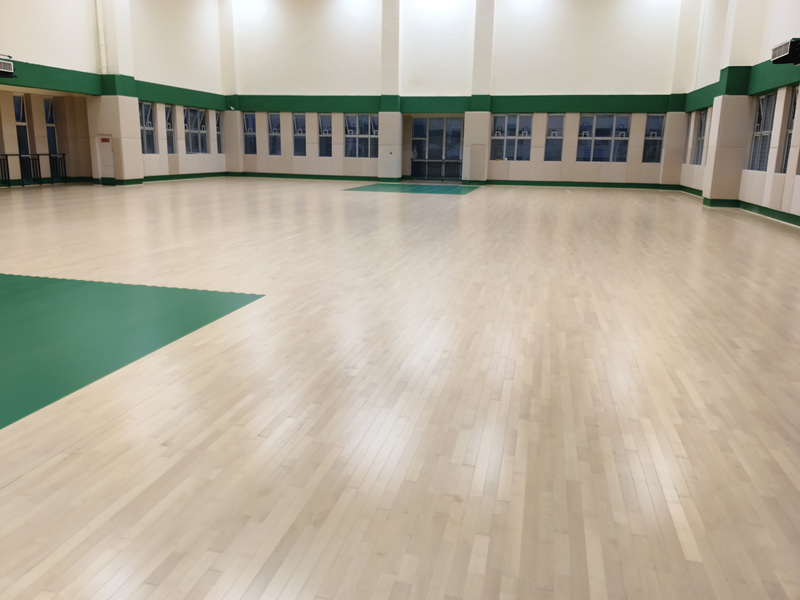
Shock absorption is one of the most critical performance characteristics of indoor sports wooden flooring. It directly affects athlete safety, comfort, and long-term joint health. Understanding the science behind shock absorption helps facility managers and designers make informed decisions about flooring systems.
Shock absorption refers to the floor's ability to reduce the impact forces that are transmitted to an athlete's body when they land from a jump or make a hard stop. When an athlete lands, the force of impact can be several times their body weight. Without adequate shock absorption, these forces are transmitted directly through the joints — knees, ankles, hips, and spine — leading to cumulative damage over time.
The technical measure of shock absorption is vertical deformation, expressed in millimeters. It is measured by dropping a standard weight onto the floor and measuring how much the surface deflects. For most indoor sports, the required vertical deformation is between 2.3mm and 5mm. Basketball typically requires 2.3mm, volleyball requires 2.3mm to 5mm, and handball requires 2.3mm to 3.5mm.
In a wood flooring system, shock absorption is achieved primarily through the underlayment — the elastic pads or mats that sit between the wood planks and the subfloor. These pads are made from materials such as rubber, foam, or a combination of both. The thickness, density, and composition of the pads determine the level of shock absorption. Thicker and softer pads provide more shock absorption but can reduce ball rebound and energy return. Thinner and firmer pads provide less shock absorption but better ball performance.
This creates a fundamental trade-off in floor design: you cannot maximize both shock absorption and ball rebound at the same time. A floor that is very soft will protect joints well but will feel "dead" and will not return the ball as crisply. A floor that is very firm will provide excellent ball performance but will transmit more impact to the athlete's body.
The best flooring systems find the optimal balance for the specific sport being played. For basketball, where ball performance is paramount, the shock absorption is kept at the minimum required level (2.3mm). For volleyball, where joint protection is more important, the shock absorption can be set higher (up to 5mm).
It is also important to note that shock absorption is not the same as cushioning. Cushioning implies a soft, spongy feel, which is not desirable for most sports. Athletes need a firm, stable surface with just enough give to protect their joints. The best wood floors feel firm underfoot but provide measurable impact reduction when tested with scientific equipment.
Leave a Reply