

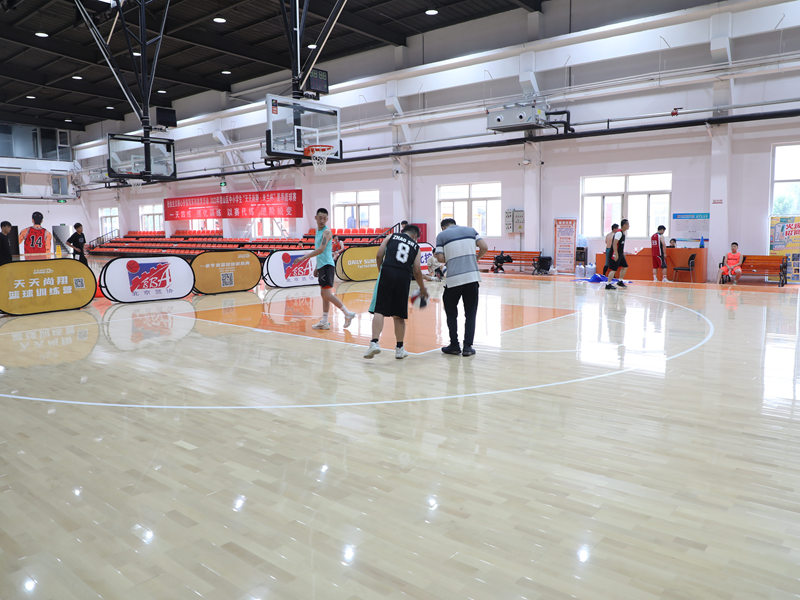
Gymnasiums and multi-purpose sports facilities present a unique challenge for flooring selection. These spaces often need to accommodate multiple sports — basketball, volleyball, badminton, gymnastics, dance, and more — on the same surface. The indoor sports wooden flooring system must be versatile enough to meet the performance requirements of several different sports while remaining durable and cost-effective.
The most common approach for multi-purpose facilities is to use a high-performance floating wood floor system with adjustable shock absorption. By varying the thickness and density of the elastic underlayment, the floor can be tuned to meet the specific requirements of each sport. For basketball, the underlayment can be set to provide 2.3mm vertical deformation. For volleyball, it can be adjusted to provide up to 5mm. This flexibility makes a single wood floor system suitable for multiple sports.
Maple remains the most popular wood species for multi-purpose facilities due to its density, durability, and consistent performance across different sports. The standard plank width is 70mm, which works well for most sports. The thickness is typically 20mm to 22mm, which provides a good balance of rigidity and shock absorption.
One of the advantages of wood flooring in multi-purpose facilities is its ability to be marked for different sports. Court lines for basketball, volleyball, badminton, and other sports can be painted directly onto the wood surface. When the facility switches from one sport to another, the lines can be easily repainted. This is much more practical than installing separate flooring systems for each sport.
The finish for multi-purpose wood floors is typically a matte or satin polyurethane with a coefficient of friction between 0.4 and 0.6. This range provides adequate traction for most sports without being too grippy for any particular one. The finish should also be durable enough to withstand the wear from multiple sports and heavy use.
Multi-purpose wood floors require more frequent maintenance than single-sport floors because they are subjected to a wider variety of stresses. Daily cleaning is essential, and the friction should be tested at least quarterly to ensure it remains within the acceptable range for all sports being played. Annual professional inspections are also recommended.
The initial cost of a multi-purpose indoor sports wooden floor is higher than a single-sport system, but it is significantly lower than installing separate floors for each sport. Over the lifespan of the facility, the wood floor system is almost always the more economical choice, especially when you factor in the ability to refinish and the long service life.
Leave a Reply