

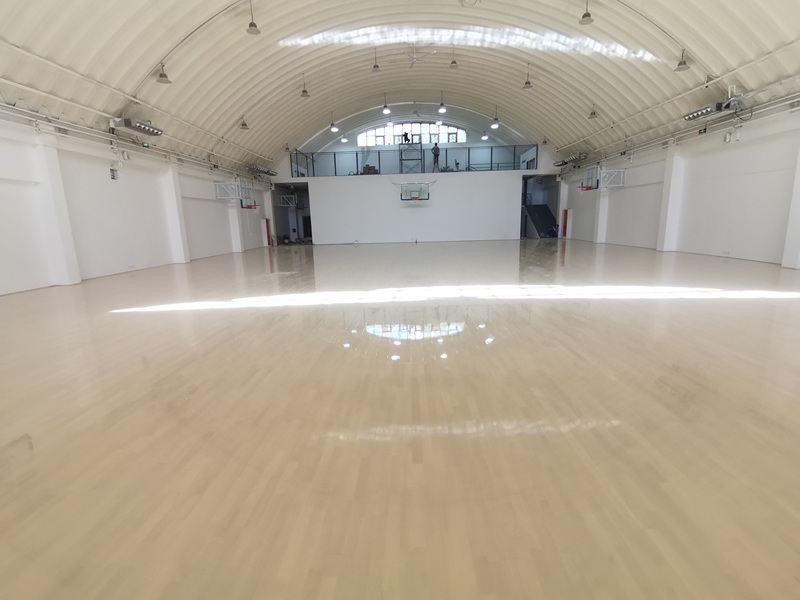
Badminton is a sport that demands precision, speed, and agility. The indoor sports wooden flooring for badminton courts must support these qualities while meeting the specific technical requirements set by the Badminton World Federation (BWF).
One of the most distinctive features of a badminton wood floor is the use of narrower planks. While basketball and volleyball courts typically use 70mm-wide planks, badminton courts often use planks that are 50mm to 60mm wide. The narrower planks create a more defined visual grid that helps players and officials see the court lines more clearly. This is particularly important in badminton, where shuttlecock placement and line calls are critical to the game.
The wood species most commonly used for badminton courts is maple, though beech and birch are also acceptable. The floor must provide a ball (shuttlecock) rebound of at least 90% from a drop height of 1 meter, as specified by BWF standards. The vertical deformation should be between 2.3mm and 3.5mm, which is on the lower end of the range to ensure a firm, responsive surface. Badminton players need a stable platform for explosive lunges and quick direction changes, so excessive shock absorption is not desirable.
The coefficient of friction for badminton courts is typically between 0.4 and 0.5. This provides enough grip for the rapid lateral movements and lunges that are characteristic of the sport, without being so grippy that it causes foot drag or increases injury risk. The finish is usually a matte or satin polyurethane with low gloss to reduce glare under arena lighting.
Another important consideration for badminton floors is the finish color. Badminton shuttlecocks are white or brightly colored, so the floor should be a light color to provide maximum contrast. Natural maple with a clear or light-tinted finish is the standard choice. Dark floors are generally avoided because they reduce visibility of the shuttlecock and the court lines.
Badminton is also a sport where sound matters. The acoustic properties of the floor can affect the playing experience. Wood floors tend to produce a pleasant, crisp sound when struck by a shuttlecock or a player's foot, which many players find preferable to the hollow sound of synthetic floors.
Maintenance for badminton wood floors follows the same general principles as other sports floors — daily sweeping, regular cleaning with pH-neutral products, and annual professional inspections. The key is to keep the surface clean and free of debris, as even small particles can affect shuttlecock movement and player traction.
Leave a Reply