

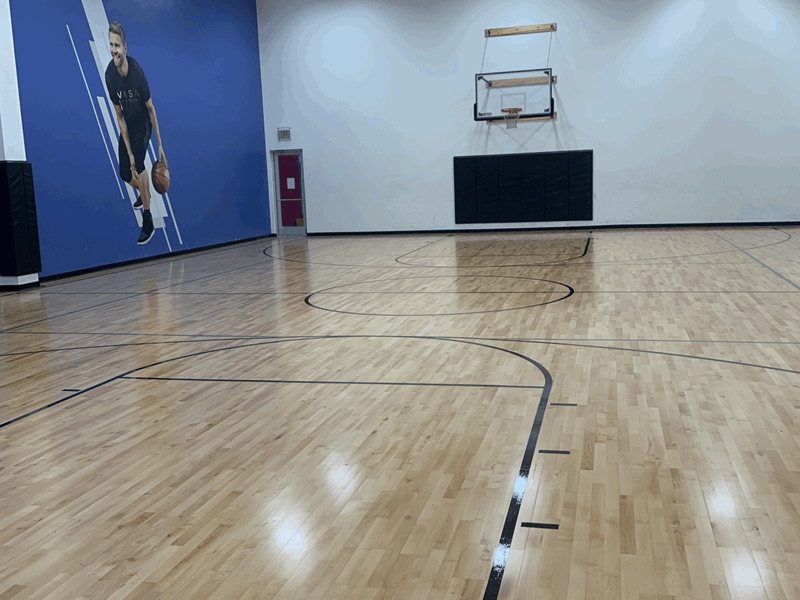
Volleyball places unique demands on indoor sports wooden flooring. Unlike basketball, which involves a lot of lateral movement and jumping, volleyball requires athletes to move in all directions — forward, backward, lateral, and rotational — often from a standing start. The floor must accommodate this multi-directional movement while providing consistent ball behavior and reliable traction.
The performance standards for volleyball wood floors are set by the International Volleyball Federation (FIVB). According to FIVB regulations, the ball rebound must be at least 90% of the drop height from 1 meter, similar to basketball. The vertical deformation must be between 2.3mm and 5mm, which is slightly more than basketball to provide additional shock absorption. This is because volleyball players spend a lot of time in a low, ready stance and are constantly exploding upward, putting significant stress on their knees and ankles.
The coefficient of friction for volleyball courts is typically set between 0.4 and 0.55, slightly lower than basketball. This is because volleyball players need to be able to slide and pivot quickly without their feet catching on the surface. A floor that is too grippy can increase the risk of knee injuries, particularly ACL tears, which are common in volleyball.
Maple is the preferred wood species for volleyball courts, just as it is for basketball. Hard maple provides the density and durability needed to withstand the constant pounding of volleyball players. The standard plank width is 70mm, with a thickness of 20mm to 22mm. The finish is a matte polyurethane that provides the right balance of grip and smoothness.
One unique consideration for volleyball courts is the color contrast. Volleyball lines must be clearly visible, and the floor color should provide good contrast with the ball (which is typically white, yellow, or blue). Light-colored maple is the standard choice because it provides excellent contrast and a clean, professional appearance.
Volleyball courts also tend to have more stringent requirements for flatness than basketball courts. Any unevenness in the surface can affect ball roll and player movement. The subfloor must be extremely flat, with no more than 2mm variation over a 2-meter straightedge.
Installing a volleyball wood floor requires the same level of precision as a basketball floor. The floating system with elastic underlayment is the most common approach, as it provides the shock absorption and ball rebound performance required by FIVB standards. With proper installation and maintenance, a volleyball wood floor can serve a facility for decades.
Leave a Reply