

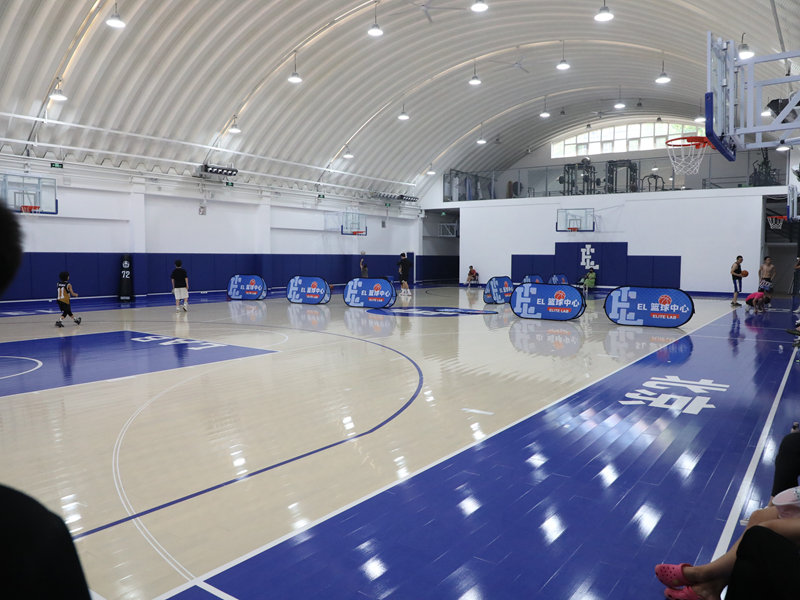
Basketball is perhaps the sport most closely associated with indoor sports wooden flooring. The iconic image of a polished hardwood court under bright arena lights is deeply embedded in the culture of the game. But there is a lot more to a basketball wood floor than just aesthetics.
The performance requirements for a basketball court are among the most demanding of any indoor sport. The floor must provide consistent ball bounce, reliable traction for quick lateral movements, and adequate shock absorption to protect players' knees, ankles, and backs. The International Basketball Federation (FIBA) and the National Basketball Association (NBA) both have specific technical standards that indoor basketball wood floors must meet.
For ball bounce, the floor must achieve a ball rebound of at least 90% of the drop height when a ball is dropped from 1.8 meters. This requires a very rigid surface with minimal energy loss. This is why professional basketball courts often use a fixed or semi-fixed system with a hard maple surface. The rigidity ensures that the ball returns to the player's hand at a predictable height, which is essential for shooting accuracy and dribbling control.
For shock absorption, the floor must achieve a minimum vertical deformation of 2.3mm when a standard test weight is applied. This protects players from the high-impact forces generated by jumping, landing, and sudden stops. The shock absorption is typically achieved through an elastic underlayment system beneath the wood planks.
For friction, the coefficient of friction must be between 0.4 and 0.6. Too little friction and players will slip. Too much friction and shoes will grip too aggressively, increasing the risk of ankle injuries and causing excessive wear on the floor surface.
Maple is the most commonly used wood species for basketball courts, particularly hard maple (Acer saccharum). It is extremely dense, has a tight grain structure, and is highly resistant to denting and wear. Oak is sometimes used as a more budget-friendly alternative, but it does not match maple's performance characteristics.
The standard plank width for basketball courts is 70mm, with a thickness of 20mm to 22mm. The finish is typically a water-based polyurethane with a matte or semi-gloss sheen. Glossy finishes are avoided because they can create glare under arena lighting and can be too slippery.
A professional-grade indoor basketball wood floor represents a significant investment, but it is also the foundation of the game. Every dribble, every jump shot, and every fast break happens on that surface. Getting it right is non-negotiable.
Leave a Reply