

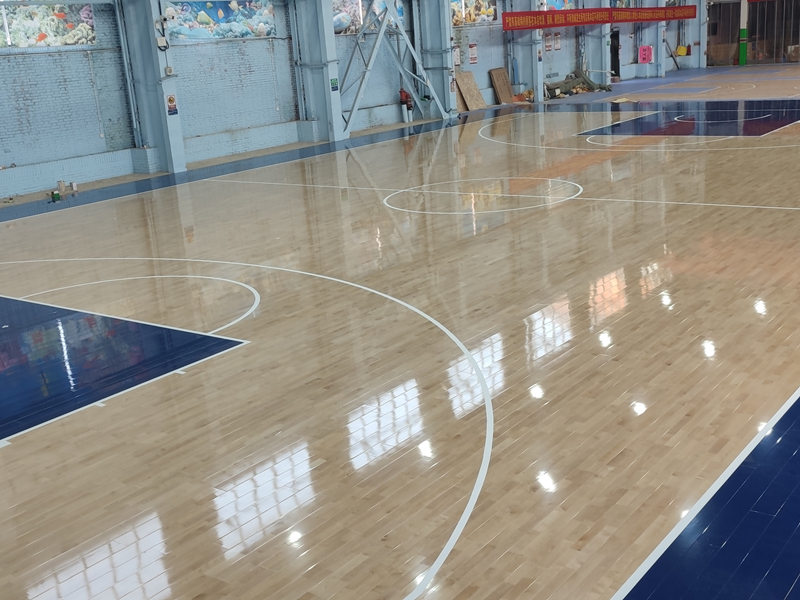
When designing a sports facility, one of the biggest decisions is choosing between indoor sports wooden flooring and synthetic alternatives such as PVC, rubber, or polyurethane surfaces. Both options have merit, but they serve different needs and priorities.
Wooden flooring offers a natural feel that synthetic materials simply cannot replicate. The ball bounce, the sound of footwork, and the overall athletic experience on wood are widely regarded as superior. Professional athletes in basketball, volleyball, and handball consistently prefer wood over any synthetic surface. This preference is not just tradition — it is based on measurable performance differences. Wood provides better energy return, more consistent ball behavior, and a more predictable friction surface.
In terms of shock absorption, both wood and synthetic floors can be engineered to meet the same standards. Modern wood flooring systems with elastic underlayment can achieve vertical deformation rates that meet or exceed those of synthetic floors. The key difference is that wood achieves this through a combination of material density and engineered underlayment, while synthetic floors rely on the inherent elasticity of the material itself.
Durability is another area where both options perform well, but in different ways. Synthetic floors are highly resistant to moisture, stains, and scratches. They require very little maintenance and can withstand heavy use with minimal degradation. Wood floors, on the other hand, are more sensitive to moisture and require regular maintenance, but they can be sanded and refinished multiple times, effectively giving them a new surface life. A well-maintained wood floor can last longer than most synthetic floors.
Cost is a significant factor. Synthetic floors are generally less expensive to purchase and install than wood floors. However, when you factor in the lifespan and the ability to refinish, wood floors often prove to be more cost-effective over the long term. A synthetic floor that needs to be replaced every 8 to 12 years can end up costing more than a wood floor that lasts 25 years with periodic refinishing.
Environmental impact is increasingly important. Wood is a renewable resource when sourced from sustainably managed forests. It is biodegradable and has a lower carbon footprint than most synthetic materials, which are derived from petroleum and are not easily recyclable. However, the finishes and adhesives used in wood flooring can contain volatile organic compounds (VOCs), so low-VOC products should be selected.
In conclusion, synthetic floors are a solid choice for budget-conscious facilities, multi-use spaces, or environments where minimal maintenance is a priority. But for any facility where athletic performance is the top priority, indoor sports wooden flooring remains the gold standard.
Leave a Reply