

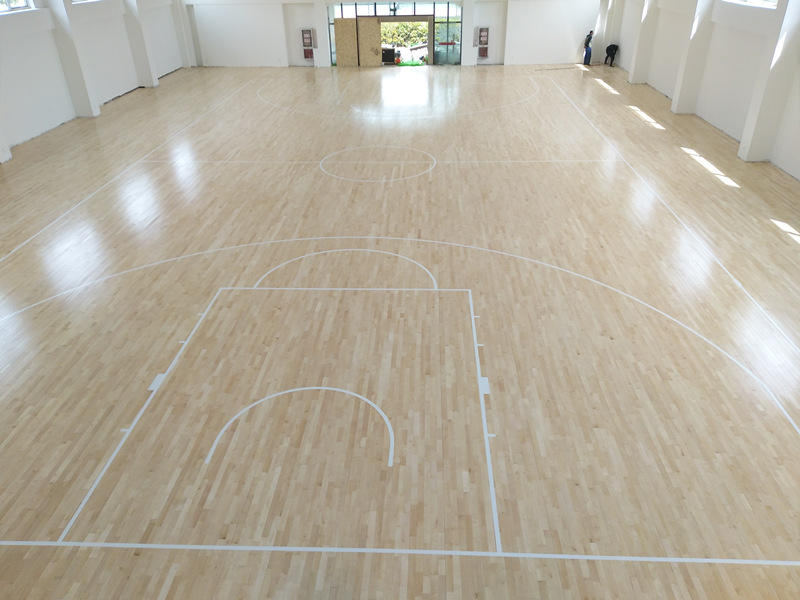
Choosing the right hardwood species for an indoor basketball court is one of the most important decisions in the planning process. While several species can be used, two dominate the market: hard maple and white oak. Each has distinct characteristics that make it suitable for different applications. Understanding the differences between these two species will help you make an informed decision based on your facility's needs, budget, and usage patterns.
Hard Maple: The Industry Standard
Hard maple, specifically sugar maple (Acer saccharum) and black maple (Acer nigrum), is by far the most commonly used species for indoor basketball courts. Its popularity is well-earned. Hard maple is extremely dense, with a Janka hardness rating of approximately 1,450, making it highly resistant to dents, scratches, and wear. This density also contributes to its excellent ball bounce characteristics and consistent performance over time.
The color of hard maple is a light, creamy blonde that provides superior visibility under gymnasium lighting. This is an important consideration, as players need to clearly see the court lines, the ball, and their teammates. The light color also makes the court feel more spacious and inviting.
Hard maple has a very tight, uniform grain pattern, which contributes to its consistency. When installed, the planks look and feel uniform across the entire court, reducing the likelihood of uneven wear or visual distraction. This uniformity is especially important in competitive settings where every visual cue matters.
One potential drawback of hard maple is its relative susceptibility to moisture. While it performs well in controlled indoor environments, it can be vulnerable to warping or cupping if exposed to excessive moisture or improper acclimation. This makes proper installation and climate control essential.
White Oak: The Durable Alternative
White oak (Quercus alba) is the second most popular species for basketball courts and offers a different set of advantages. White oak has a Janka hardness rating of approximately 1,360, which is slightly lower than hard maple but still very hard and durable. Its most significant advantage over maple is its superior moisture resistance. White oak contains tyloses, which are cellular structures that block the movement of water through the wood. This makes white oak far less prone to swelling, warping, or cupping in humid conditions.
The color of white oak is darker than maple, ranging from light tan to medium brown. While this can reduce visibility slightly compared to maple, many facilities find the warmer tone aesthetically pleasing. The darker color can also hide scuffs and wear better than the light color of maple, which may be an advantage in high-traffic facilities.
White oak has a more pronounced grain pattern than maple, which some players and facility managers find visually appealing. However, this more open grain can trap dirt and debris more easily, requiring more diligent cleaning.
Performance Comparison
In terms of ball bounce, both species perform excellently and are well within the standards set by governing bodies such as FIBA and the NBA. The difference in energy return between the two is negligible in practical terms. Both provide the consistent, lively bounce that players expect.
In terms of traction, both species offer good grip when properly finished. Some players report a slightly different feel underfoot, with oak feeling marginally firmer, but this is largely a matter of personal preference.
In terms of durability, white oak has a slight edge in moisture-prone environments, while hard maple has a slight edge in pure wear resistance. For most indoor basketball courts, which are climate-controlled, the difference is minimal.
Cost Considerations
Hard maple is generally more expensive than white oak, primarily due to its higher demand and more limited supply. The price difference can range from 10 to 25 percent depending on market conditions. If budget is a primary concern and the facility is in a humid climate, white oak may be the more practical choice.
The Recommendation
For most indoor basketball courts, hard maple is the recommended choice. Its superior hardness, light color, and uniform appearance make it the ideal surface for competitive play. White oak is an excellent alternative, particularly for facilities in humid climates or for owners who prefer a warmer aesthetic and want the added moisture protection.
Leave a Reply