

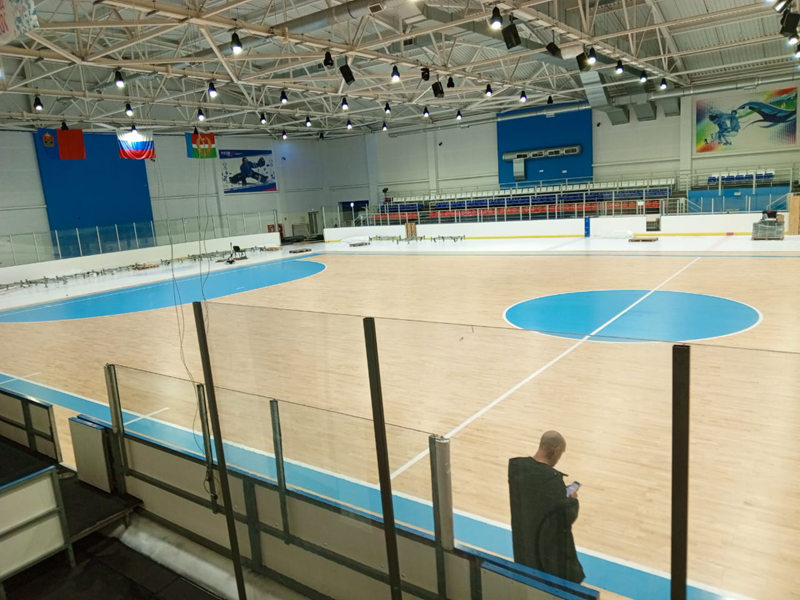
Installing hardwood flooring on an indoor basketball court is one of the most demanding applications in the flooring industry. The requirements for flatness, stability, and performance are far more stringent than for residential hardwood. A poorly installed court can lead to uneven play, premature wear, player injuries, and costly repairs. This article walks through the complete installation process, from subfloor preparation to final finishing.
Phase 1: Subfloor Preparation
The foundation of any basketball court hardwood installation is the subfloor. The subfloor is typically plywood or OSB (oriented strand board) installed over a concrete slab. Before any hardwood is laid, the subfloor must meet strict flatness and levelness requirements. The industry standard, as defined by the NWFA and ASTM, requires that the subfloor not deviate more than 3/16 inch over a 10-foot span. Any areas that exceed this tolerance must be shimmed, sanded, or patched.
Moisture testing is also critical at this stage. The moisture content of the concrete slab should be measured using a calcium chloride test or a relative humidity probe. The subfloor moisture content should be below 12 percent before hardwood installation begins. If moisture levels are too high, a moisture barrier or a specialized underlayment must be installed to prevent moisture migration into the hardwood.
Phase 2: Acclimation
Once the subfloor is ready, the hardwood planks must be acclimated to the environment of the facility. This process typically takes a minimum of 48 to 72 hours, during which the wood adjusts to the temperature and humidity of the space. Skipping or rushing this step is one of the most common causes of post-installation problems, including cupping, crowning, and gapping.
The planks should be stored in the installation area in their original packaging, stacked flat, and allowed to reach equilibrium with the surrounding environment. The ideal conditions for acclimation are a temperature between 60 and 80 degrees Fahrenheit and a relative humidity between 30 and 50 percent.
Phase 3: Layout and First Row
The installation begins with the first row, which must be perfectly straight and square to the walls. This row serves as the reference for all subsequent rows. A chalk line is snapped along the subfloor to guide the placement of the first row. The planks are laid with a 3/8-inch expansion gap around the entire perimeter of the court to allow for seasonal movement.
Spacers are placed at the ends of each plank to maintain consistent spacing between rows. This expansion gap is critical — without it, the wood will have no room to expand and contract with changes in humidity, leading to buckling or crowning.
Phase 4: Fastening the Planks
There are three primary methods for fastening hardwood to a basketball court subfloor: nail-down, glue-down, and floating.
The nail-down method is the most common for basketball courts. Nails are driven through the tongue of each plank into the subfloor at a 45-degree angle. This method provides a very secure bond and is preferred for high-traffic areas. The nails are typically spaced every 8 to 12 inches along the joists.
The glue-down method uses a high-strength adhesive to bond the planks directly to the subfloor. This creates a very stable, rigid surface but makes future repairs more difficult, as individual planks cannot be easily removed.
The floating method involves laying the planks on top of a foam underlayment without attaching them to the subfloor. The entire floor "floats" as a single unit. This method allows for natural expansion and contraction but is less common in basketball courts because it can result in slight movement that affects ball bounce consistency.
Phase 5: Sanding and Finishing
After all planks are installed, the floor is sanded in a series of progressively finer grits. The first pass uses a coarse grit (typically 36 to 50) to level the surface and remove any imperfections. Subsequent passes use medium grits (60 to 80) and fine grits (100 to 120) to create a smooth, uniform surface.
The finishing process involves applying a high-performance polyurethane coating designed for athletic floors. This finish must be thin, flexible, and durable. Typically, three to five coats are applied, with light sanding between each coat. The final coat is usually a matte or satin finish to reduce glare under gymnasium lighting while still providing adequate protection.
Phase 6: Line Painting and Final Inspection
Once the finish has cured (typically 24 to 48 hours after the final coat), the court lines are painted. The lines must be applied with precision, as they define the playing area. After the lines are painted and cured, a final inspection is conducted to check for any defects, unevenness, or finishing issues.
The entire installation process, from subfloor prep to final inspection, typically takes two to four weeks for a standard-sized court, depending on the complexity of the project and the size of the crew.
Leave a Reply