

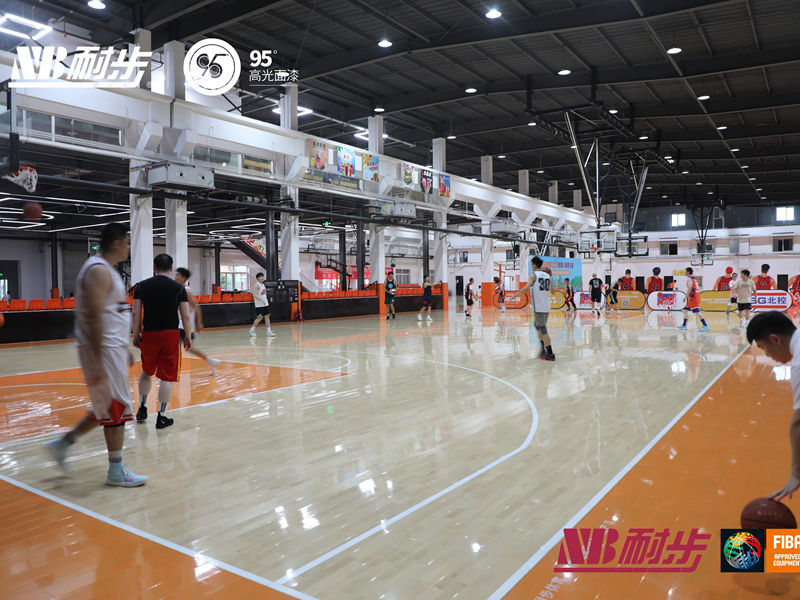
The world of indoor sports is changing, and the floor is leading the revolution. Detachable sports wood flooring is no longer a niche product for elite facilities. It is becoming the standard for schools, community centers, commercial gyms, and even residential sports rooms. The reason is simple: flexibility wins.
For decades, the standard approach to indoor sports flooring was to install a fixed system and live with it. If you built a basketball court, you had a basketball court. If you wanted to switch to volleyball, you were out of luck unless you invested in a completely new floor. This rigidity created enormous waste, both in terms of money and materials. Facilities that could only serve one purpose were underutilized, and the flooring itself often deteriorated faster than expected because it was not designed for the variety of stresses it actually endured.
Detachable sports wood flooring solves this problem at its root. By using a modular, interlocking design, these floors can be reconfigured for different sports, different court sizes, and even different layouts within the same sport. A full-size basketball court can become two half-court setups for training drills. A volleyball court can be converted into a pickleball area in minutes. This level of adaptability was simply not possible with traditional fixed flooring.
But the benefits go far beyond reconfiguration. Let us talk about installation. Traditional sports flooring requires a lengthy process involving adhesives, curing times, and highly skilled labor. If something goes wrong, the entire floor may need to be redone. Detachable systems eliminate most of these risks. The panels click or lock together using mechanical fasteners, and the entire floor can be installed by a smaller crew in a fraction of the time. For facility managers dealing with tight schedules and limited budgets, this is a game changer.
Maintenance is equally transformed. With a fixed floor, any damage to the surface often means sanding, refinishing, or replacing large sections. This is not only expensive but also creates dust, noise, and downtime. With a detachable system, you simply lift out the damaged panel and slot in a new one. The rest of the floor remains untouched. Over a ten-year period, this difference in maintenance cost can be staggering.
Transportability is another advantage that is often overlooked. Because the panels are not permanently attached, they can be disassembled and moved to a new location. This is incredibly valuable for temporary facilities, pop-up sports events, or organizations that relocate. You are not throwing away your investment every time you move. You are taking it with you.
From an environmental perspective, detachable flooring is also a smarter choice. Because panels can be reused, refurbished, and recycled, the overall material consumption is significantly lower than with disposable fixed systems. The hardwood top layer can be sanded and refinished multiple times, extending its useful life well beyond what a fixed floor could achieve.
The performance characteristics of detachable sports wood flooring are also worth highlighting. Modern systems are engineered to meet or exceed the same standards as fixed floors in terms of shock absorption, ball rebound, vertical deformation, and surface friction. There is no performance trade-off for the convenience of detachability. In fact, some detachable systems outperform fixed floors in certain metrics because the underlayment can be more precisely engineered when the floor is designed as a modular unit from the start.
As indoor sports continue to grow in popularity, the demand for facilities that can serve multiple purposes will only increase. Detachable sports wood flooring is not just a trend. It is the logical evolution of a technology that finally matches the reality of how modern sports facilities are actually used.
Leave a Reply