

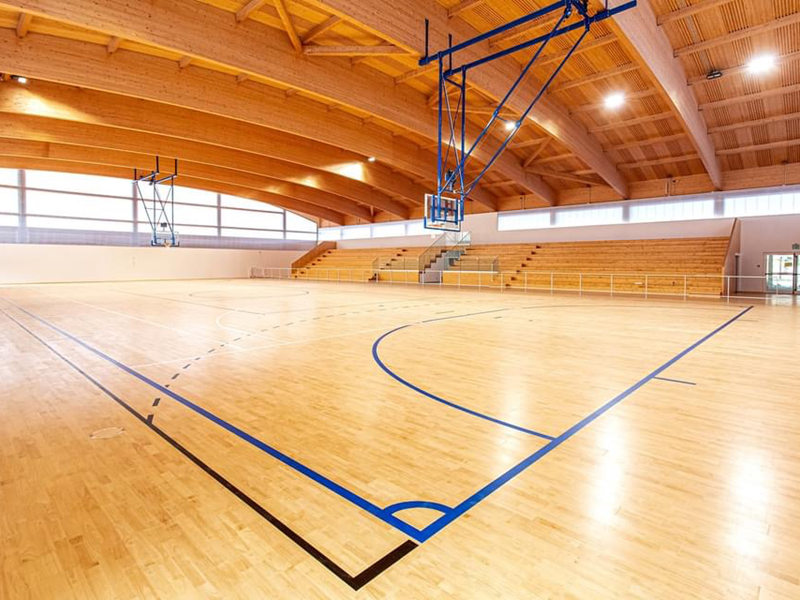
When it comes to indoor sports facilities, the flooring you choose can make or break the entire experience. Among the many options available today, detachable indoor sports wood flooring has emerged as one of the most practical and versatile solutions. But what exactly is it, and why should you care?
Detachable indoor sports wood flooring refers to a modular flooring system designed specifically for athletic environments. Unlike traditional fixed flooring that is permanently bonded to the subfloor, detachable systems are engineered to be assembled, disassembled, and relocated without significant damage to the panels or the underlying structure. This fundamental difference changes everything about how facilities are built, maintained, and used.
The core concept behind detachable sports wood flooring is modularity. Each panel is manufactured to precise specifications so that it fits together with neighboring panels in a seamless, interlocking fashion. The connections are typically mechanical rather than adhesive, which means the floor can be taken apart piece by piece and reassembled elsewhere. This is not a gimmick. It is a serious engineering solution to a very real problem: indoor sports facilities need to be flexible.
Consider a school gymnasium that hosts basketball games on Monday, volleyball practice on Tuesday, a dance recital on Wednesday, and a community event on Saturday. A fixed flooring system would be optimized for one sport and compromise everything else. A detachable system, on the other hand, can be configured differently for each use case. The same panels that form a basketball court on one day can be rearranged into a badminton court layout the next.
The materials used in detachable sports wood flooring are carefully selected to balance performance, durability, and weight. The top layer is typically a hardwood species such as maple, oak, or beech, chosen for its density, grain pattern, and resistance to wear. Beneath the hardwood surface, there is usually a multi-layer plywood or high-density fiberboard core that provides structural stability. The bottom layer often includes a moisture barrier and a shock-absorption layer made from foam, rubber, or a combination of both.
One of the most important performance metrics for any sports floor is shock absorption. When an athlete jumps and lands, the floor must absorb enough impact to protect joints and reduce injury risk, but not so much that it feels mushy or slows down movement. Detachable systems achieve this through their underlayment design. The shock-absorption layer is calibrated to meet international standards such as those set by the International Basketball Federation or the International Handball Federation, depending on the intended sport.
Ball rebound is another critical factor. A good sports floor should return a consistent percentage of the ball's energy on impact. Too much rebound and the ball becomes uncontrollable. Too little and the game feels dead. Detachable wood flooring systems are tested to ensure ball rebound falls within the acceptable range for the sport being played.
The detachable nature of these floors also has significant implications for facility management. When a panel gets damaged, it can be individually replaced without tearing up the entire floor. This is a massive cost saver over the lifetime of the facility. With fixed flooring, a single damaged section often requires cutting out and replacing a large area, which is both expensive and disruptive.
Installation time is another area where detachable systems shine. Because the panels are pre-finished and interlock mechanically, a full-size court can often be installed in a matter of days rather than weeks. This means less downtime for the facility and faster return to use.
In summary, detachable indoor sports wood flooring is not just an alternative to traditional fixed floors. It is a superior solution for facilities that need flexibility, durability, ease of maintenance, and high performance. Whether you are building a new gym, renovating an existing one, or managing a multi-purpose sports hall, this technology deserves serious consideration.
Leave a Reply