

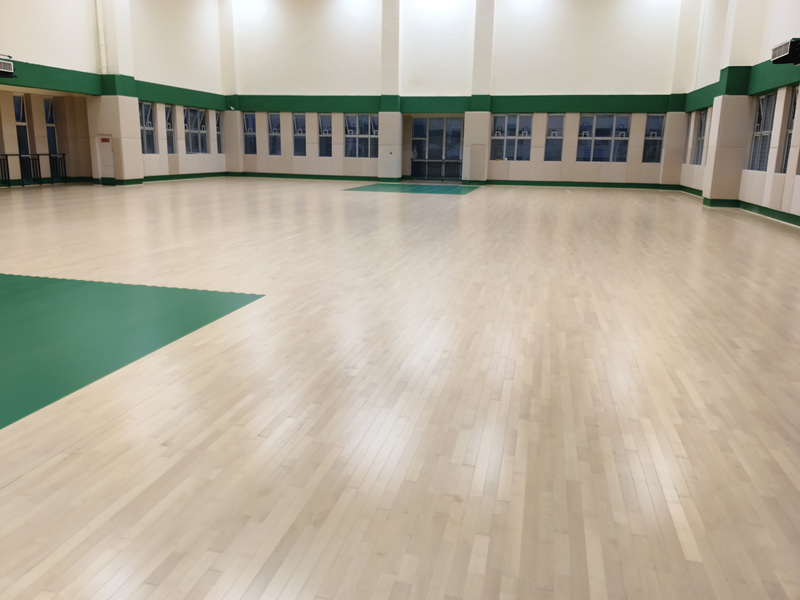
The portable basketball court wood flooring of today bears little resemblance to the simple plywood-on-pallets systems of the past. Modern portable floors are sophisticated engineered products that combine advanced materials science, precision manufacturing, and clever mechanical design. Understanding the technology behind these systems helps you appreciate why they perform so well and what to look for when shopping.
The core material is where the technology starts. The best portable systems use solid hardwood, typically maple, for the core layer. Maple is chosen for its density, hardness, and consistent grain structure, all of which contribute to excellent ball bounce and durability. Some systems use engineered wood, which consists of a thin hardwood veneer bonded to a stable plywood or composite core. Engineered wood is less expensive and more dimensionally stable, meaning it resists warping and cupping better than solid wood in fluctuating humidity conditions.
The multi-layer construction is a key innovation. A typical panel consists of five to seven layers: a top wear layer of hardwood, a decorative layer that can be stained to match any color, a core layer for structural strength, a bottom stabilizing layer to prevent warping, and sometimes an intermediate layer of foam or rubber for shock absorption. Each layer is bonded under heat and pressure a panel that is stronger and more stable than any single piece of wood.
Precision milling is what makes portable systems work. Every edge of every panel is machined to tolerances of less than 0.5mm. This ensures that when panels are connected, the surface is perfectly flat with no gaps or lips. The tongue-and-groove or click-lock connection systems are designed to be both secure and easy to assemble. Some systems use metal reinforcement clips that snap into place, providing additional holding force without tools.
Surface treatment technology has also advanced significantly. Modern finishes use UV-cured coatings that harden instantly under ultraviolet light, creating a surface that is extremely durable and resistant to scuffing. These finishes are also much thinner than traditional polyurethane, which means they do not alter the feel of the wood underfoot. Anti-slip additives can be incorporated into the finish to improve traction without making the surface feel gritty.
Moisture protection technology includes full-edge sealing, where every cut surface of the panel is coated with a moisture-resistant compound. This prevents water from penetrating the wood fibers, which is the primary cause of swelling, warping, and delamination. Some systems also include a built-in vapor barrier layer that further protects against moisture migration from the subfloor.
The subfloor interface is another area of innovation. Some portable systems include interlocking base tiles that create a perfectly level platform for the wood panels. These tiles are made from high-density polyethylene or recycled rubber and can be laid over any flat surface, including concrete, asphalt, or even grass. This eliminates the need for extensive subfloor preparation and allows the court to be set up almost anywhere.
All of these technologies work together to create a portable flooring system that performs at a level that would have been impossible just a decade ago. When evaluating portable options, look for systems that incorporate as many of these technologies as possible. The upfront cost may be higher, but the performance and longevity will justify the investment.
Leave a Reply