

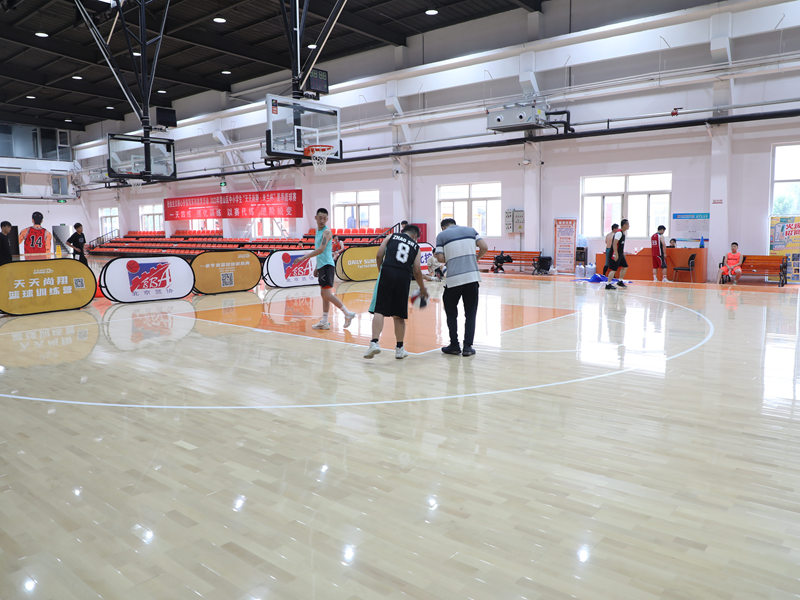
Sustainability is no longer a niche concern. It is a central consideration for schools, municipalities, corporations, and sports organizations when making purchasing decisions. Portable basketball court wood flooring has several environmental advantages over permanent alternatives, but it also has some limitations that deserve honest examination.
The most significant environmental advantage of portable flooring is reusability. A permanent hardwood court is installed once and stays in place for 20 to 30 years. When it is eventually removed, the wood is often sent to a landfill. A portable floor, by contrast, can be installed, used, disassembled, transported, and reinstalled at a new location multiple times over its lifespan. This dramatically reduces the total amount of wood needed to serve multiple venues. If a portable floor serves three different locations over its life, the per-use environmental impact is roughly one-third of a permanent floor.
Wood itself is a renewable resource when sourced responsibly. Most portable basketball court flooring uses hardwood species like maple, birch, or oak, which can be sustainably harvested from managed forests. Look for flooring certified by organizations that verify sustainable forestry practices. The wood in a portable floor can also be recycled or repurposed at the end of its life, unlike synthetic surfaces that often end up in landfills.
The manufacturing process for portable flooring is generally less resource-intensive than permanent installation. Permanent courts require extensive subfloor preparation, including concrete pouring or plywood installation, adhesive application, and multiple coats of finish. Portable systems arrive pre-finished and require minimal on-site processing, reducing both material waste and energy consumption during installation.
Transportation is the environmental weak point. Portable flooring must be moved between locations, which consumes fuel and generates emissions. For organizations that move their court frequently, the transportation footprint can be significant. Mitigation strategies include optimizing transport routes, using fuel-efficient vehicles, and consolidating moves to reduce the number of trips.
The finish and coatings used on portable flooring also have environmental implications. Water-based finishes are significantly more environmentally friendly than solvent-based alternatives, producing fewer volatile organic compounds and less hazardous waste. Modern portable systems increasingly use water-based polyurethane or UV-cured finishes that meet strict environmental standards.
End-of-life disposal is another consideration. When a portable floor reaches the end of its useful life, the wood panels can often be reclaimed for other purposes, such as furniture, wall paneling, or even mulch. The metal connection hardware can be recycled. This is a much cleaner end-of-life profile than synthetic sports surfaces, which are notoriously difficult to recycle.
In summary, portable basketball court wood flooring is a more environmentally responsible choice than most alternatives, particularly when the floor is reused across multiple locations. The key is to maximize reuse, choose responsibly sourced wood, and dispose of the floor responsibly at the end of its life.
Leave a Reply