

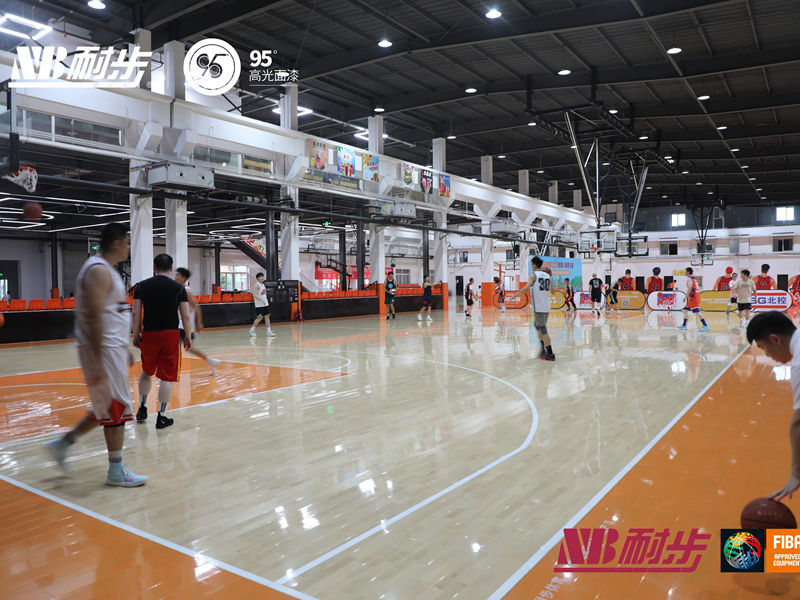
The indoor basketball court has evolved dramatically over the past few decades. What was once a simple concrete slab with a painted line layout has become a sophisticated athletic surface engineered for performance, safety, and durability. At the center of this evolution is the rise of demountable sports wood flooring, a technology that is quietly reshaping how we think about court construction.
To understand why demountable systems are becoming the standard, it helps to look at the problems that traditional fixed wood flooring creates. Fixed hardwood courts are permanently attached to the subfloor using nails, screws, or adhesive. This means that once the floor is installed, it is essentially stuck in place. If you want to move it, you have to destroy it. If you want to access the subfloor for repairs, you have to tear up the entire court. If a single panel is damaged, you often have to replace a large section because the boards are continuously fastened together.
Demountable sports wood flooring solves all of these problems. By using a system of mechanical connectors, each floor panel is independent. It can be lifted, moved, stored, and reinstalled without any loss of performance or structural integrity. This is not a minor convenience. It is a fundamental shift in how athletic floors are designed and used.
The performance of modern demountable systems is now virtually indistinguishable from fixed installations. The top layer is still premium hardwood, typically maple, which provides the ideal combination of hardness, grip, and ball response. The sub-layers provide shock absorption and structural support. The demountable connectors are engineered to hold the panels firmly in place during play while still allowing easy removal when needed.
One of the biggest drivers of this trend is the growing demand for multi-use facilities. Schools, community centers, churches, and corporate wellness centers all need spaces that can serve multiple purposes. A gymnasium might host basketball in the morning, volleyball in the afternoon, and a community event in the evening. With a demountable sports wood floor, the court can be quickly converted between these uses. The floor panels are removed, stored in a compact stack, and then reinstalled in a new layout within hours.
This flexibility also has significant financial implications. A fixed hardwood floor is a sunk cost. Once it is installed, it is tied to that specific location forever. A demountable floor, on the other hand, is an asset that can be moved. If a school is renovating or relocating, the floor can be taken with them. This portability adds real value to the investment.
From an environmental perspective, demountable systems are also more sustainable. Because the floor can be disassembled and reused, there is less waste generated at the end of its life. Panels that are damaged can be replaced individually rather than discarding the entire court. The hardwood itself can be refinished multiple times, extending its useful life even further.
The installation speed of demountable systems is another major advantage. A traditional fixed hardwood court can take two to four weeks to install, depending on the size and complexity. A demountable court of the same size can be installed in three to seven days. This faster timeline means less disruption to the facility and earlier access to the court.
Looking ahead, the demand for demountable sports wood flooring is only going to increase. As more facilities adopt multi-use designs and as the cost of traditional construction continues to rise, the economic and practical advantages of demountable systems will become even more compelling. This is not just a trend. It is the direction the industry is moving.
Leave a Reply