

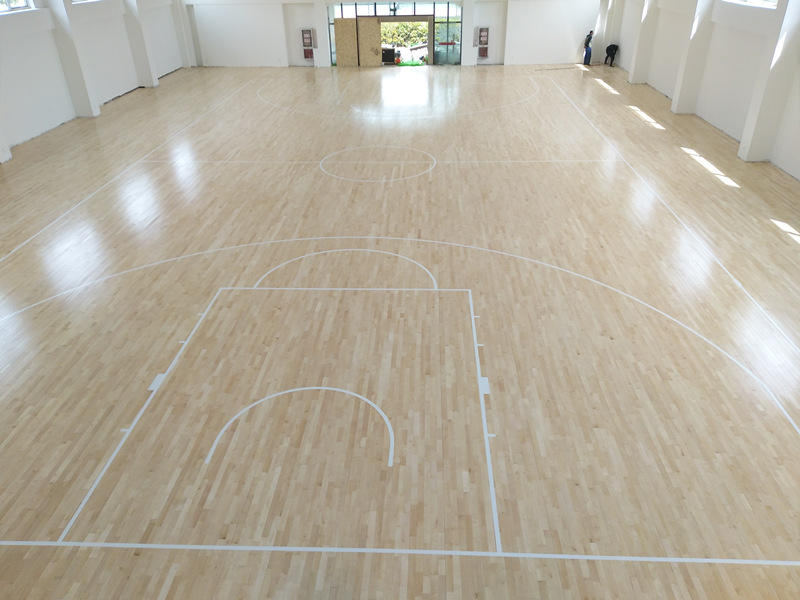
A demountable indoor basketball court floor is not a single piece of wood. It is a carefully engineered multi-layer system, with each layer serving a specific purpose. Understanding this construction is essential for anyone involved in purchasing, installing, or maintaining such a floor.
The topmost layer is the playing surface. This is the layer that players actually interact with, and it must meet strict performance standards. The most common species used for this layer is hard maple, specifically sugar maple or rock maple, because of its density, uniformity, and resistance to wear. Oak and ash are also used in some applications, though maple remains the gold standard for basketball. The thickness of this top layer typically ranges from 20 millimeters to 26 millimeters, depending on the system and the intended use.
Beneath the top layer is the structural layer, usually made from plywood or high-density fiberboard. This layer provides the rigidity and flatness that the playing surface needs. It also serves as the base to which the demountable connectors are attached. The quality of this layer is critical because any warping or unevenness here will be felt on the playing surface above.
The third layer is the shock absorption layer. This is where demountable systems really shine in terms of engineering. Unlike fixed floors, which rely on the natural flex of the wood and the subfloor for shock absorption, demountable systems incorporate dedicated cushioning materials. These can include polyurethane foam pads, rubber mats, or spring-loaded systems. The purpose of this layer is to reduce the impact forces on players' joints, particularly their knees, ankles, and lower backs. The thickness and density of this layer can be customized based on the level of play and the specific requirements of the facility.
The bottom layer is the demountable connector system. This is what makes the entire floor removable. There are several types of connectors used in the industry. Some systems use a clip-and-rail mechanism where each panel slides into a rail and is held in place by a clamp. Others use a bolt-and-nut system where panels are fastened to the subfloor with threaded rods. The most advanced systems use a combination of both, providing both lateral stability and vertical security.
One important aspect of the layered construction is the moisture barrier. Wood and moisture are natural enemies, and indoor basketball courts are not immune to humidity issues. A good demountable system includes a moisture barrier between the subfloor and the structural layer to prevent moisture from wicking up into the wood. This is especially important in basements or buildings with poor ventilation.
The total thickness of a demountable sports wood floor typically ranges from 65 millimeters to 85 millimeters, depending on the system. This is thicker than many fixed hardwood installations, but the extra thickness is necessary to accommodate the demountable connectors and the shock absorption layer.
Each layer must be precisely manufactured and installed. If the top layer is not perfectly flat, the ball bounce will be inconsistent. If the shock absorption layer is uneven, players will experience different levels of cushioning from one spot to another. If the demountable connectors are not properly aligned, the panels will shift during play, creating a safety hazard.
The beauty of the layered approach is that it allows each component to be optimized independently. The top layer can be selected for performance, the structural layer for stability, the shock absorption layer for player safety, and the connector system for flexibility. This modularity is what makes demountable sports wood flooring so effective and so adaptable.
Leave a Reply