

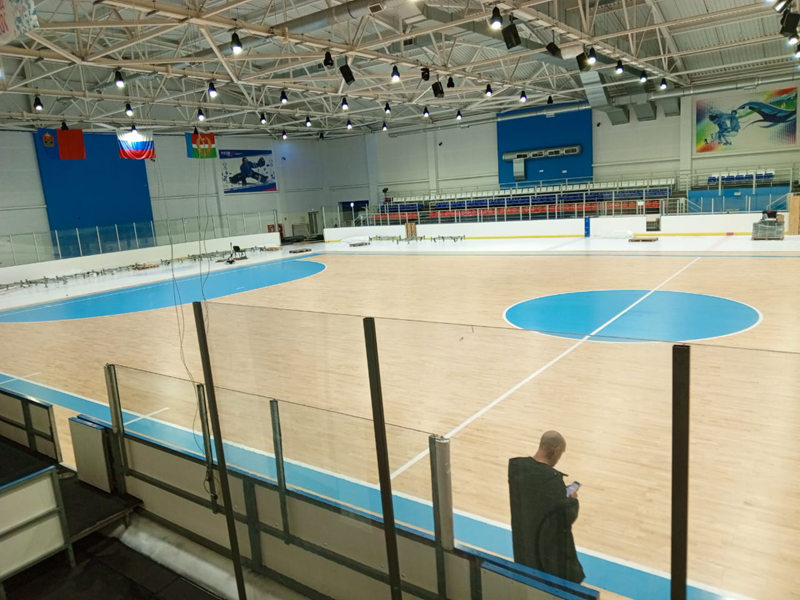
Installing a demountable sports wood floor for an indoor basketball court is a precise process that requires careful planning and skilled labor. While the process is faster than traditional hardwood installation, it is not something that should be rushed. Every step matters, and mistakes at any stage can compromise the performance and safety of the finished court.
The first step is subfloor preparation. The subfloor must be flat, clean, dry, and structurally sound. For concrete subfloors, this means checking for cracks, uneven spots, and moisture levels. The surface should be ground smooth if necessary, and a moisture barrier should be applied. For wood subfloors, the existing surface should be inspected for any loose boards or structural issues. In both cases, the subfloor must meet a flatness tolerance of no more than three millimeters over any three-meter span.
Once the subfloor is ready, the next step is to lay out the shock absorption layer. This is typically done using either foam pads or rubber mats that are cut to fit the court dimensions. The pads are placed in a grid pattern with minimal gaps between them. Some systems use interlocking foam tiles that snap together, while others use individual pads that are taped down. The key is to ensure complete coverage with no gaps, as any gap will result in a hard spot on the finished court.
After the shock absorption layer is in place, the structural layer is installed. This is usually plywood or high-density fiberboard panels that are laid over the cushioning. These panels are fastened to the subfloor using the demountable connector system. At this stage, the panels are not yet connected to each other. They are simply secured to the ground.
The next step is to lay the playing surface. The hardwood panels, typically maple, are installed over the structural layer. These panels are connected to each other using tongue-and-groove joints or a similar interlocking mechanism. The direction of the wood grain is important and should run parallel to the length of the court for optimal performance. Each panel is also fastened to the structural layer below using screws or clips, depending on the system.
Once all the playing surface panels are in place, the court is sanded. This is a multi-stage process that starts with coarse-grit sandpaper to remove any unevenness or splinters, followed by progressively finer grits to achieve a smooth, uniform surface. The final sanding stage typically uses 120-grit or 150-grit sandpaper.
After sanding, the court is cleaned thoroughly to remove all dust. Any remaining dust will interfere with the finish application. The court is then inspected for any defects, gaps, or uneven spots that need to be addressed before finishing.
The finish application is the next critical step. Most indoor basketball courts use a sports-grade polyurethane finish or a UV-cured lacquer. The finish is applied in multiple thin coats, with light sanding between each coat. The number of coats varies by system, but typically three to five coats are applied. The finish provides the final surface friction, protects the wood from moisture and wear, and gives the court its characteristic shine.
The final step is to paint the court lines. This is usually done with a contrasting color using a stencil system. The lines must be precise and meet official basketball court dimensions.
The entire installation process, from subfloor preparation to final line painting, typically takes three to seven days for a standard-sized indoor court. The exact timeline depends on the size of the court, the complexity of the demountable system, and the experience of the installation crew.
Leave a Reply