

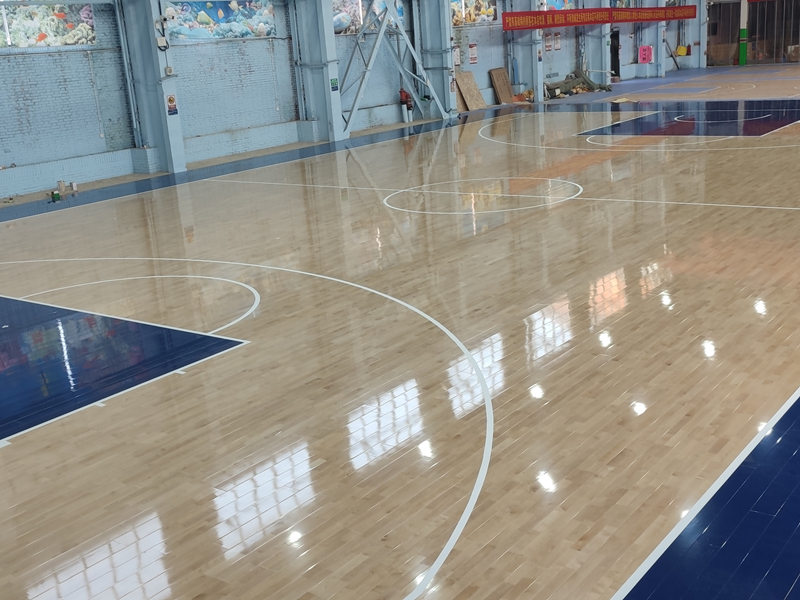
When you invest in a demountable sports wood floor for an indoor basketball court, you are not just buying a surface to stand on. You are buying a performance system that must meet specific technical standards. These standards cover ball bounce, shock absorption, surface friction, flatness, and vertical deformation. Understanding these standards helps you evaluate whether a particular floor system is right for your facility.
Ball bounce is one of the most visible performance metrics. It is measured by dropping a basketball from a height of 1.8 meters and measuring the rebound height. The standard requires that the ball bounce between 1.2 meters and 1.4 meters, which corresponds to a rebound percentage of 67 to 77 percent. This range ensures that the ball behaves predictably, neither too dead nor too lively. Demountable systems are tested using the same methods as fixed floors, and modern systems consistently meet or exceed these standards.
Shock absorption is measured using a standardized test device that simulates the impact of an athlete's foot. The device drops a weighted impactor onto the floor surface, and the force transmitted through the floor is measured. The standard typically requires a shock absorption rate of at least 35 percent, meaning that at least 35 percent of the impact force is absorbed by the floor rather than transmitted back to the player. Higher shock absorption rates are better for player health, but there is a trade-off with ball bounce. Too much cushioning can make the ball feel dead. The best demountable systems find the sweet spot between shock absorption and ball response.
Surface friction, also known as the coefficient of friction, measures how grippy the floor is. This is critical for basketball because players need to be able to stop, start, and change direction quickly without slipping. The standard requires a coefficient of friction between 0.4 and 0.6. Too low, and players will slip. Too high, and the floor will feel sticky, which can cause knee injuries. Demountable systems achieve the right friction level through a combination of the wood species, the finish type, and the surface texture.
Flatness is measured by placing a straightedge across the floor and measuring the maximum gap between the straightedge and the floor surface. The standard typically requires a flatness tolerance of no more than two millimeters over any one-meter span. This ensures that the ball rolls true and that players do not trip on uneven spots. Demountable systems can achieve excellent flatness because the panels are individually leveled during installation.
Vertical deformation measures how much the floor compresses under load. This is tested by applying a specific force to the floor and measuring the deflection. The standard typically requires a vertical deformation of between 0.6 millimeters and 1.5 millimeters. This range ensures that the floor is firm enough for good ball response but flexible enough to absorb impact.
All of these tests are conducted according to international standards, and reputable demountable floor manufacturers will provide test reports for their systems. When evaluating a floor, always ask for these reports. They are the best evidence that the floor will perform as promised.
Leave a Reply