

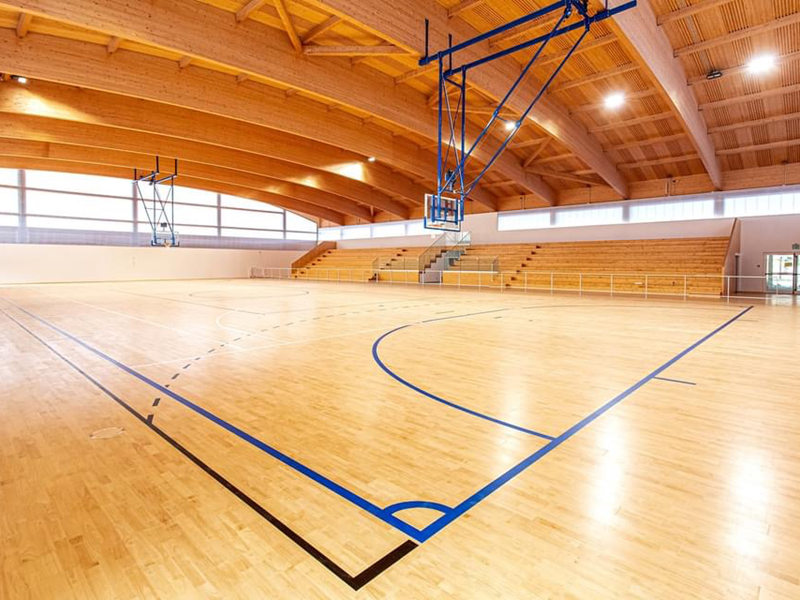
When it comes to indoor basketball courts, the flooring is arguably the most critical component of the entire facility. It determines how players perform, how safe they are, and how long the court will last. Among the many options available today, demountable sports wood flooring has emerged as one of the most practical and versatile solutions for basketball facilities of all sizes.
Demountable sports wood flooring, also known as modular or removable sports wood flooring, is a system designed specifically for indoor athletic courts that can be assembled, disassembled, relocated, and reassembled without significant damage to the material. Unlike traditional fixed hardwood floors that are permanently nailed or glued to the subfloor, demountable systems use mechanical fastening methods, interlocking joints, or clip-based connections that allow each panel to be individually removed and reinstalled.
The primary reason this type of flooring has gained so much popularity is flexibility. Many schools, community centers, and multi-purpose venues need to convert their basketball courts into spaces for volleyball, badminton, concerts, or other events. With a demountable system, this conversion can happen in hours rather than days. The floor panels are lifted, stored, and then reinstalled in a different configuration if needed.
The construction of a demountable sports wood floor typically involves multiple layers. The top layer is the actual playing surface, usually made from hard maple, oak, or ash — the same species used in professional NBA arenas. Beneath the surface layer, there is a layer of plywood or high-density fiberboard that provides structural stability. Below that, there is often a shock-absorption layer made from polyurethane foam, rubber, or a combination of both. The bottom layer consists of the demountable connectors and support structures that attach to the subfloor.
One of the most misunderstood aspects of demountable sports wood flooring is the assumption that it is inferior to fixed installations. This is simply not true. Modern demountable systems are engineered to meet the same performance standards as permanently installed floors. They provide comparable ball bounce, shock absorption, and surface friction. The difference lies in how they are attached to the ground, not in how they perform once installed.
Another advantage is the ease of maintenance. Because each panel can be removed individually, damaged sections can be replaced without tearing up the entire court. If one panel gets scratched, dented, or warped, you simply unclip it and slide in a new one. This dramatically reduces long-term maintenance costs and downtime.
The installation process for a demountable sports wood floor is also faster than traditional hardwood installation. Since there is no need for adhesive or nails, the subfloor preparation is less intensive. The panels are laid out in a specific pattern, connected to each other using the interlocking system, and then secured to the subfloor using the demountable fasteners. A standard indoor basketball court can be fully installed in as little as three to five days, depending on the size and complexity of the system.
In terms of cost, demountable sports wood flooring is generally more expensive upfront than a simple fixed hardwood floor. However, when you factor in the savings from reduced maintenance, the ability to relocate the floor, and the extended lifespan of the system, the total cost of ownership is often lower over a ten to fifteen year period.
For facility managers, the decision between demountable and fixed flooring often comes down to usage patterns. If the court is dedicated solely to basketball and will never need to be converted, a fixed floor may be sufficient. But if the space needs to serve multiple functions, demountable sports wood flooring is almost always the smarter investment.
In summary, demountable sports wood flooring represents the best of both worlds. It delivers the premium playing experience that serious basketball players and coaches demand, while offering the flexibility and practicality that modern multi-use facilities require. Whether you are building a new court or upgrading an existing one, this technology deserves serious consideration.
Leave a Reply