

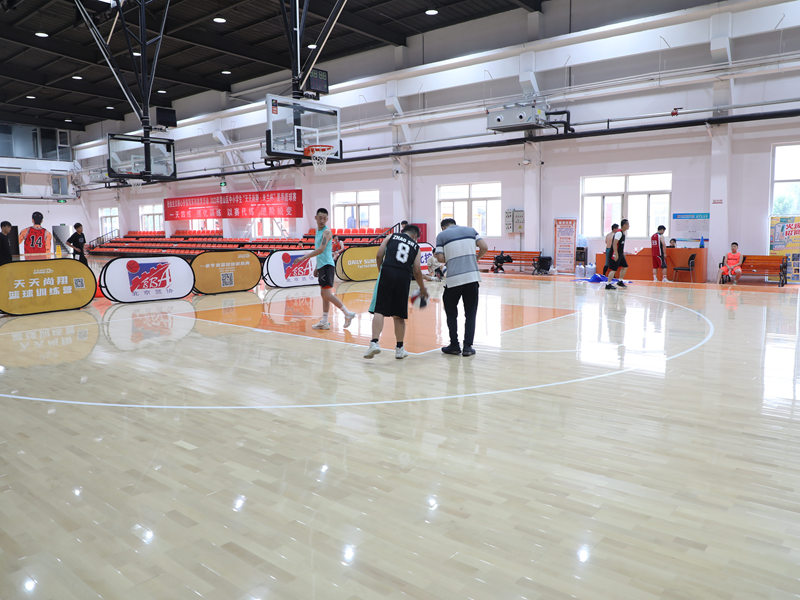
The NBA, WNBA, NCAA, and FIBA all use wooden floors for their official games. These are not just any wooden floors — they are the finest examples of basketball court flooring in the world, engineered to meet exacting standards of performance, safety, and aesthetics. By studying what professional basketball courts use and how they maintain their floors, we can learn valuable lessons about wooden flooring excellence that apply to courts of all levels.
The NBA Standard: Perfection in Every Detail
The NBA specifies that all official game courts must use hard maple wood, specifically sugar maple from the northeastern United States or eastern Canada. The planks must be at least 19 millimeters thick and 67 millimeters wide, though most modern courts use planks that are 22 millimeters thick and 70 millimeters wide.
The NBA also has strict requirements for the finish. The floor must have a gloss level between 52 and 60 gloss units (GU), as measured by a gloss meter. This range provides the optimal balance of traction and ball grip. The finish must also meet specific friction requirements to ensure player safety.
Perhaps the most impressive aspect of NBA court flooring is the consistency. The ball bounce must be uniform across the entire court, with no more than a 6 millimeter variation in bounce height from one point to another. This level of precision requires expert installation and meticulous maintenance.
The NCAA Standard: College-Level Excellence
The NCAA has similar requirements to the NBA, with a few key differences. NCAA courts also use hard maple, but the specifications for plank thickness and width are slightly different. The NCAA allows for a wider range of gloss levels, typically between 40 and 60 GU, depending on the facility.
One interesting difference is that NCAA courts often feature team logos and branding at center court, which requires additional painting and finishing work. This adds complexity to the installation process but also creates a unique identity for each program.
FIBA and International Standards
FIBA, the international governing body for basketball, has its own set of specifications for wooden court flooring. FIBA courts use hard maple and have similar requirements for thickness, width, and finish. However, FIBA courts are slightly smaller than NBA courts (28 meters by 15 meters compared to 28.65 meters by 15.24 meters), which affects the total amount of wood needed.
FIBA also places a strong emphasis on the environmental sustainability of the materials used. Many FIBA-approved floors now use FSC-certified wood and low-VOC finishes.
Lessons for Recreational Courts
While most recreational facilities cannot afford to replicate the exact specifications of a professional court, there are many lessons that can be applied. First, the choice of wood matters. Hard maple is the best performer, but if budget is a constraint, red oak is a solid alternative. Second, the finish is critical. Investing in a quality polyurethane finish will extend the life of the floor and improve performance.
Third, the subfloor is just as important as the surface. Professional courts use engineered subfloor systems that provide shock absorption and structural stability. Recreational facilities should not cut corners on the subfloor, as a poor subfloor will undermine even the best wood.
Fourth, maintenance is non-negotiable. Professional teams spend significant time and money maintaining their courts. Daily cleaning, humidity control, and regular refinishing are all essential. Recreational facilities should adopt similar practices, even if on a smaller scale.
The Technology Behind the Scenes
Professional basketball courts also benefit from advanced technology that is not always available to recreational facilities. Moisture sensors embedded in the subfloor can alert facility managers to potential problems before they become serious. Automated climate control systems maintain the ideal temperature and humidity year-round. Some arenas even use robotic floor cleaners that can polish the entire court overnight.
While these technologies are expensive, they demonstrate the level of care that goes into maintaining a professional wooden floor. The lesson is clear: a wooden basketball court is not a set-it-and-forget-it investment. It requires ongoing attention and care to perform at its best.
The Legacy of Wood
One of the most inspiring aspects of professional basketball court flooring is its legacy. Many NBA arenas have been using the same wooden floors for decades, refinishing them repeatedly to keep them in top condition. The Boston Celtics' parquet floor at the old Boston Garden is legendary, and the floor at the Los Angeles Lakers' Crypto.com Arena has hosted countless historic moments.
These floors are more than just playing surfaces — they are part of the history of the game. They connect current players and fans to the legends who played on them before. This is something that no synthetic surface can replicate.
In conclusion, professional basketball courts set the standard for wooden flooring excellence. By studying their specifications, materials, and maintenance practices, we can build better courts at every level and ensure that the tradition of wooden basketball flooring continues for generations to come.
Leave a Reply