

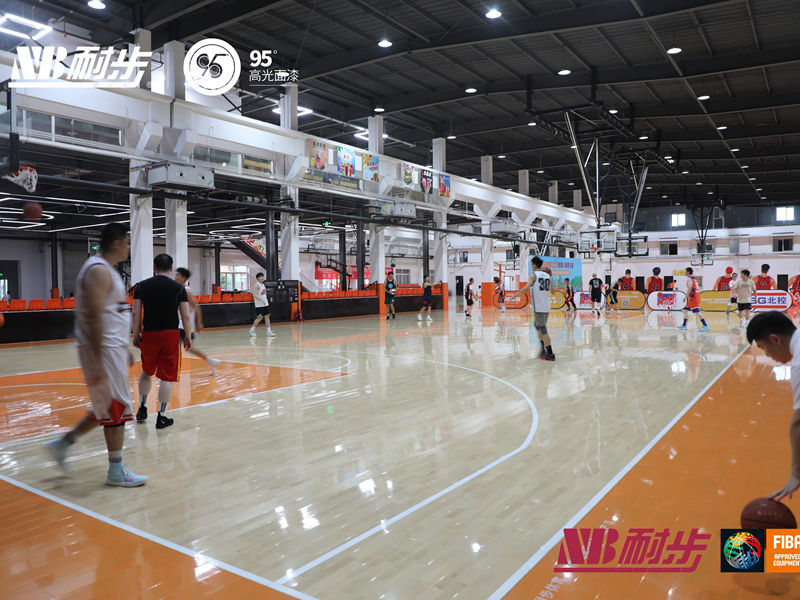
The species of wood used in an indoor basketball court has a profound impact on every aspect of the playing experience — from the way the ball bounces to how the floor feels under a player's feet, from the durability of the surface to the aesthetic appeal of the entire gymnasium. While there are many types of hardwood available, only a select few are truly suited for the demands of competitive basketball. Understanding the characteristics of each species will help you make an informed decision when selecting flooring for your facility.
Hard maple is undeniably the king of indoor basketball court flooring. It is the species used in virtually every professional and collegiate arena across North America. The reason for its dominance lies in its physical properties. Hard maple, specifically sugar maple, has a Janka hardness rating of approximately 1,450 pounds. This means it is extremely resistant to denting, scratching, and wear — all of which are inevitable on a basketball court where players are constantly stopping, starting, pivoting, and landing from jumps. The tight, uniform grain of maple also contributes to a consistent ball bounce. When a basketball hits a maple floor, the energy is returned evenly, giving players a predictable and reliable bounce that is essential for dribbling, passing, and shooting.
Maple also has a light, natural color that is highly versatile. It can be stained to match any team color scheme, or it can be left in its natural state for a clean, classic look. The light color also has a practical benefit: it reflects more light, which means the gymnasium can be lit with fewer fixtures, saving on energy costs. Additionally, the light color makes it easier to see scuff marks and dirt, which encourages more frequent cleaning and better hygiene.
Red oak is the second most commonly used species for basketball courts, though it is more common in recreational and high school settings than in professional arenas. Oak has a Janka hardness of about 1,290 pounds, which is still very hard but slightly softer than maple. This means oak is somewhat more susceptible to dents and surface damage over time. However, oak has a more pronounced grain pattern than maple, which gives it a distinctive, attractive appearance. The grain can also provide slightly more grip for players' shoes, which some players prefer.
One advantage of oak is its availability and cost. Oak is more abundant than hard maple in many regions, which makes it a more affordable option. For facilities with limited budgets, oak can provide a very good playing surface at a lower price point. The trade-off is that oak floors may need to be refinished more frequently than maple floors, which adds to the long-term cost.
Birch is another species that is sometimes used for basketball courts, particularly in Europe. Birch has a Janka hardness of about 1,260 pounds, making it comparable to oak. It has a very fine, even grain that produces a smooth playing surface with excellent ball bounce characteristics. Birch is lighter in color than maple, almost white in some varieties, which gives courts a bright, modern appearance. However, birch is not as widely available in North America, which can make it more expensive and harder to source for large-scale projects.
Ash is a species that was used more commonly in the past but has largely fallen out of favor for basketball courts. Ash has a Janka hardness of about 1,320 pounds, which is actually quite respectable. However, ash has a more open, porous grain structure that can trap dirt and moisture, making it harder to clean and maintain. Ash is also more prone to splitting along the grain, which can be a problem in a high-traffic environment like a gymnasium. Despite these drawbacks, ash is still used in some multi-purpose facilities where basketball is only one of several sports played on the floor.
European beech has emerged as a strong competitor to maple in recent years. Beech has a Janka hardness of approximately 1,300 pounds, which is slightly less than maple but still more than adequate for basketball. Beech has a very uniform, tight grain that provides consistent ball bounce and a smooth playing surface. It is also more readily available in Europe, which makes it a cost-effective alternative for facilities in that region. Beech takes stain very well, allowing for a wide range of color options. Some facilities have even used beech to replicate the look of maple at a fraction of the cost.
Hickory is occasionally used for basketball courts, though it is more common in bowling alleys and other high-traffic commercial spaces. Hickory has a Janka hardness of about 1,820 pounds, making it one of the hardest domestic wood species available. This extreme hardness makes hickory incredibly durable, but it also makes it more difficult to work with during installation. Hickory has a dramatic, varied grain pattern that gives it a rustic, distinctive look, but this look may not appeal to all facility owners.
When choosing a wood species, you must balance several factors: hardness, availability, cost, appearance, and maintenance requirements. For competitive play at any level above recreational, hard maple remains the best overall choice. For budget-conscious projects, oak or beech can provide excellent value. For facilities that want a unique aesthetic, birch or hickory might be worth considering. Whatever species you choose, make sure it is sourced from sustainably managed forests and that it meets the grading standards required for athletic flooring.
The species of wood is just one piece of the puzzle. The construction method, thickness, finish, and subfloor system all play equally important roles in determining the final performance of the court. But if you start with the right species, you have laid a strong foundation for a floor that will serve your athletes well for many years to come.
Leave a Reply