

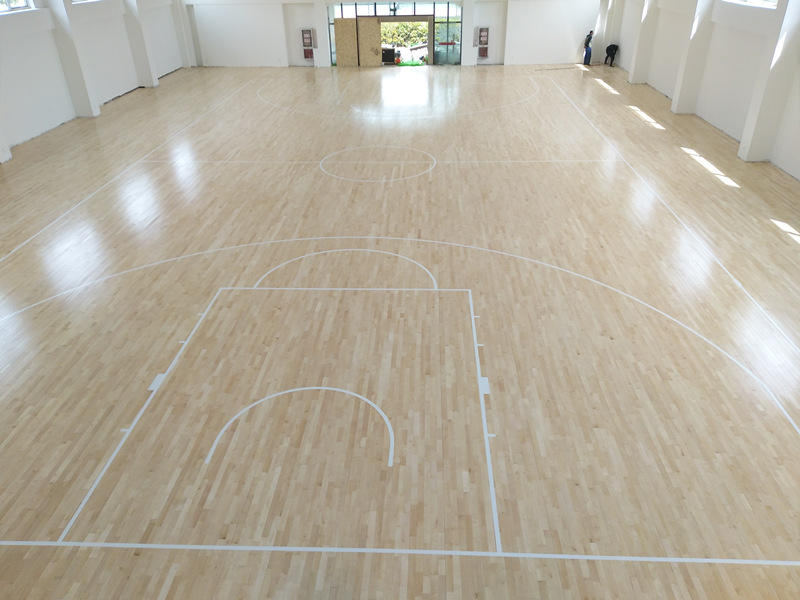
Understanding the different types and materials used in indoor sports wooden flooring is crucial for making an informed purchasing decision. Not all sports wood floors are created equal, and the differences in species, construction, and finish can have a profound impact on performance, durability, and cost. Let us dive deep into the various types and materials available.
Hardwood Species
The three primary hardwood species used in indoor sports flooring are maple, oak, and beech.
Maple, particularly hard maple (Acer saccharum), is the most widely used species for professional basketball courts in North America. It is prized for its extreme hardness (1450 on the Janka hardness scale), light color, and tight grain pattern. The light color of maple also makes it easier to see the ball and the lines on the court, which is why the NBA requires maple for its courts.
Oak, available in both red and white varieties, is the most popular choice in Europe and for multipurpose facilities. Red oak has a Janka hardness of 1290, while white oak is slightly harder at 1360. Oak has a more pronounced grain pattern than maple, giving it a distinctive and attractive appearance. It is also more affordable than maple, making it a popular choice for schools and community centers.
Beech (Fagus sylvatica) is the dominant species used in European professional basketball courts. With a Janka hardness of 1300, beech offers excellent durability and a very uniform, light-colored appearance. It is slightly less hard than maple but provides comparable performance characteristics.
Floor Construction Types
Indoor sports wooden flooring comes in several construction types, each suited to different applications.
Single-layer solid wood flooring consists of one thick plank of hardwood, typically 20-26mm thick. This is the traditional construction method and is used in most professional sports arenas. It offers the best performance and durability but requires a very stable subfloor.
Multilayer engineered flooring consists of a top layer of hardwood bonded to multiple layers of plywood or other wood products. This construction is more dimensionally stable and can be installed over a wider range of subfloor conditions. It is commonly used in schools and training facilities.
Floating floor systems are another option, where the planks are not directly attached to the subfloor but instead rest on a layer of foam or rubber. This system provides excellent shock absorption and is easier to install, but it is generally not recommended for high-level competition.
Surface Finishes
The finish applied to indoor sports wooden flooring affects both its appearance and performance.
Polyurethane finishes are the most common for sports floors. They provide a durable, slip-resistant surface that can be easily maintained. A matte or semi-gloss finish is typically used to reduce glare while still providing enough shine for a professional look.
UV-cured finishes are increasingly popular because they cure instantly under ultraviolet light, creating an extremely hard and durable surface. These finishes are more resistant to scuffing and scratching than traditional polyurethane.
Oil-based finishes are less common in sports applications but are used in some European facilities. They penetrate the wood rather than sitting on top, providing a more natural feel but requiring more frequent maintenance.
Accessory Materials
Beyond the wood itself, several accessory materials are integral to a complete indoor sports wooden flooring system. Shock pads made of polyurethane foam or recycled rubber are placed between the subfloor and the wood to provide impact absorption. Moisture barriers protect the wood from ground moisture. Expansion gaps and edge trim ensure the floor can move naturally without buckling.
By understanding these various types and materials, facility managers and architects can specify the exact flooring system that best meets their performance requirements, budget constraints, and aesthetic preferences.
Leave a Reply