

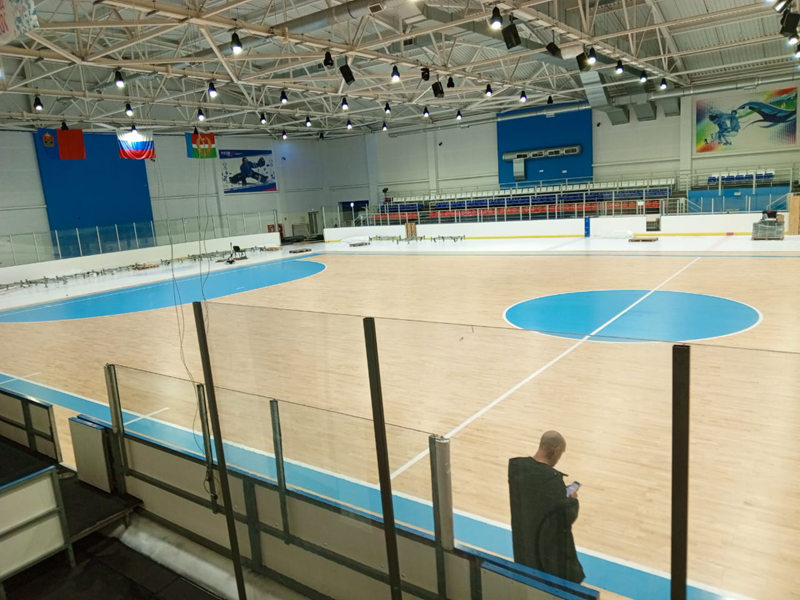
The installation of indoor sports wooden flooring is a highly specialized process that requires skilled craftsmanship, precise equipment, and strict adherence to industry standards. A poorly installed sports floor can lead to performance issues, premature wear, and even safety hazards. This article provides a detailed look at the step-by-step installation process.
Step 1: Subfloor Preparation
The installation process begins with the subfloor, which is typically made of concrete or plywood. The subfloor must be completely flat, with a maximum deviation of 2mm per 2 meters. Any high spots are ground down, and low spots are filled with leveling compound. The subfloor must also be completely dry, with a moisture content below 2% for concrete or 8-12% for plywood. Moisture testing is conducted using either a calcium chloride test or a relative humidity probe.
Step 2: Moisture Barrier Installation
Once the subfloor is prepared and verified to be dry, a moisture barrier is installed. This is typically a polyethylene sheet that is laid over the entire subfloor and sealed at all seams with tape. The moisture barrier prevents any residual moisture from the subfloor from migrating into the wood flooring, which could cause warping, cupping, or mold growth.
Step 3: Shock Absorption Layer
The shock absorption layer is installed next. This can be either a system of individual foam pads placed at regular intervals or a continuous sheet of foam or rubber. The thickness and density of the shock pad are selected based on the required DIN rating for the specific sport. For a professional basketball court, the shock pad must provide a DIN rating between 35% and 53%.
Step 4: Load-Bearing Structure
In many installation systems, a load-bearing layer of plywood or oriented strand board (OSB) is installed over the shock pads. This layer distributes the load evenly across the floor and provides a stable, flat surface for the hardwood planks. The boards are typically 18-22mm thick and are screwed or glued to the subfloor.
Step 5: Acclimatization
The hardwood planks must be acclimatized to the facility's environment before installation. This typically takes 48 to 72 hours and involves storing the planks in the installation room at the same temperature and humidity conditions that will exist in the finished facility. This step is critical to prevent the wood from expanding or contracting after installation.
Step 6: Plank Installation
The actual installation of the hardwood planks begins at one end of the room and progresses systematically across the floor. Planks are typically installed using either a tongue-and-groove system with floating installation or a nail-down method. In the floating method, the planks are glued together at the tongue and groove and then floated over the subfloor, allowing for natural expansion and contraction. In the nail-down method, the planks are directly fastened to the subfloor at regular intervals.
Step 7: Sanding and Finishing
After all planks are installed, the floor is sanded to create a perfectly smooth, level surface. This is typically done in three stages: coarse sanding to remove any gaps or unevenness, medium sanding to smooth the surface, and fine sanding to prepare for the finish. The finish is then applied in multiple coats, with light sanding between each coat. Most sports floors receive two to three coats of polyurethane or UV-cured finish.
Step 8: Line Painting and Final Inspection
The final step is the painting of court lines and logos, followed by a comprehensive inspection to ensure the floor meets all performance and aesthetic standards. The DIN rating, ball bounce, and surface friction are all tested and documented.
Proper installation is the foundation of a high-performance indoor sports wooden floor. Investing in certified installers and following industry best practices will ensure that your floor delivers optimal performance for decades.
Leave a Reply