

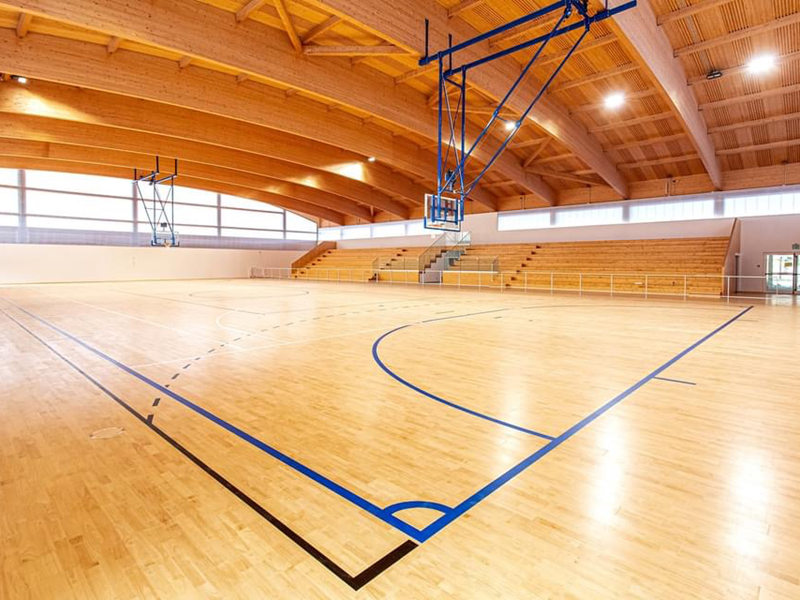
Indoor basketball wood flooring is one of the most demanding surfaces in all of sports construction. Unlike residential hardwood or commercial office flooring, a basketball court must withstand thousands of pounds of dynamic force every single day. Players slam, pivot, slide, and sprint across the surface, and the floor must respond with consistent performance, safety, and durability. This guide covers everything you need to know about indoor basketball wood flooring, from the materials used to the engineering principles that make it work.
The foundation of any indoor basketball wood floor begins with the subfloor. Before any hardwood is even considered, the structural base must be perfectly level. Concrete slabs, plywood decks, or steel-framed systems all serve as the starting point. The subfloor must meet strict flatness tolerances, typically no more than three millimeters of deviation over a three-meter span. If the base is not level, the finished floor will develop soft spots, uneven bounce, and premature wear.
Once the subfloor is prepared, the next layer is the shock pad or underlayment. This layer serves a critical function: it absorbs impact and returns energy to the player. A good shock pad system reduces stress on joints, which is especially important for competitive athletes who train and play for hours at a time. The thickness and density of the underlayment vary depending on the level of play. A recreational gym might use a thinner pad, while a professional facility requires a multi-layered system with precise performance ratings.
The top layer is the hardwood itself. Maple is by far the most common species used for indoor basketball courts, and for good reason. Hard maple, specifically Acer saccharum, has a Janka hardness rating of around 1450, making it dense enough to resist denting from heavy athletic shoes. It also has a tight, uniform grain that provides consistent ball response. Other species like birch and oak are sometimes used, but they lack the combination of hardness, stability, and aesthetics that maple delivers.
The planks are typically installed in a tongue-and-groove pattern, which locks them together and creates a seamless playing surface. The width of each plank usually ranges from 60 to 70 millimeters, and the thickness is commonly 20 to 22 millimeters. These dimensions are not arbitrary. They are the result of decades of testing and refinement to balance durability, flexibility, and ball bounce consistency.
Finishing the floor is the final step, and it is where many performance decisions are made. The finish acts as a protective barrier against moisture, scuffs, and wear. It also affects the gloss level of the surface, which in turn influences how light reflects off the court and how players perceive the playing conditions. Most indoor basketball floors use a matte or semi-gloss finish to reduce glare under arena lighting.
Beyond the physical construction, indoor basketball wood flooring must also meet specific performance standards. Organizations like FIBA, the NBA, and the NCAA all publish detailed specifications for court surfaces. These standards cover everything from the coefficient of friction to the vertical deformation of the floor under load. A floor that does not meet these standards cannot be used for sanctioned competition.
In summary, indoor basketball wood flooring is far more than just a pretty wooden surface. It is a precisely engineered system designed to protect athletes, enhance performance, and last for decades with proper maintenance. Understanding each layer and its function is the first step toward making informed decisions about your court.
Leave a Reply