

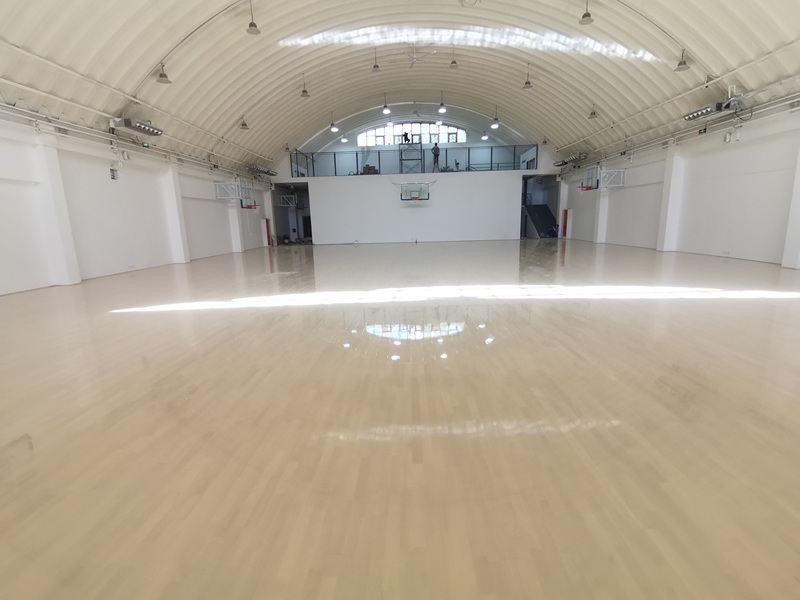
Traction is the single most important performance characteristic of any basketball playing surface, and indoor basketball court wood flooring is widely celebrated for its ability to deliver a perfectly balanced level of grip that no other synthetic surface can match. Traction on a wood court is not just a simple matter of "how sticky the floor is"; it is a complex interaction between three separate elements: the texture of the wood’s top surface, the properties of the athletic finish applied to it, and the tread pattern of the rubber on the bottom of basketball shoes. The ideal level of traction for basketball is a narrow sweet spot: if the floor is too slippery, players’ feet will slide out from under them when they try to make a sudden stop, leading to embarrassing turnovers and dangerous falls. If the floor has too much traction, the rubber of the shoe will stick to the surface too firmly, preventing the foot from turning naturally when a player tries to pivot, which puts enormous torque on the knee joint and drastically increases the risk of ACL and meniscus injuries. Indoor basketball court wood flooring is uniquely capable of hitting this perfect sweet spot, because the natural texture of the wood grain creates thousands of tiny micro-abrasions that grip the shoe rubber without being sharp or aggressive enough to catch and tear the tread.
Over the course of a game, the traction of indoor basketball court wood flooring changes in subtle but predictable ways. At the start of a game, when the floor is completely clean and dry, the surface has a slightly higher level of traction, which gives players maximum grip for their first few warmup movements. As play goes on, tiny amounts of dust, rubber particles worn off the soles of shoes, and small drops of sweat get deposited on the surface, creating a very thin, almost invisible layer of debris that slightly reduces the coefficient of friction. This is why professional venue staff wipe down the court at every timeout: they are not just cleaning for appearance, they are removing that thin layer of debris to restore the floor’s traction back to its optimal level. One of the biggest advantages of wood flooring over synthetic surfaces is that this debris does not get trapped in the pores of the surface; it sits on top, so it can be completely removed with a simple mop, restoring the floor’s traction to 100% of its original state. On many synthetic surfaces, the debris gets embedded in the textured top layer, making it impossible to fully remove, so the traction of the surface slowly degrades permanently over time.
The finish system applied to indoor basketball court wood flooring is specifically engineered to preserve this ideal traction balance for as long as possible. Unlike generic floor finishes that are designed for residential or office use, athletic wood floor finishes are formulated to have a very specific, non-yellowing texture that maintains its grip characteristics even after thousands of hours of foot traffic. As the finish wears down slowly over years of play, the fine grain of the wood underneath is gradually exposed, creating a fresh new textured surface that continues to deliver consistent traction, rather than turning smooth and slippery like a fully synthetic surface would. This means that a well-maintained indoor basketball court wood flooring can maintain its perfect traction for 10, 15, or even 20 years, without ever needing to be fully resurfaced. This long-term consistency of traction is one of the biggest reasons that professional players consistently report that they feel more confident and safer playing on a wood court, because they know exactly how the surface will respond to every movement, no matter how many hours of play it has seen.
Leave a Reply