

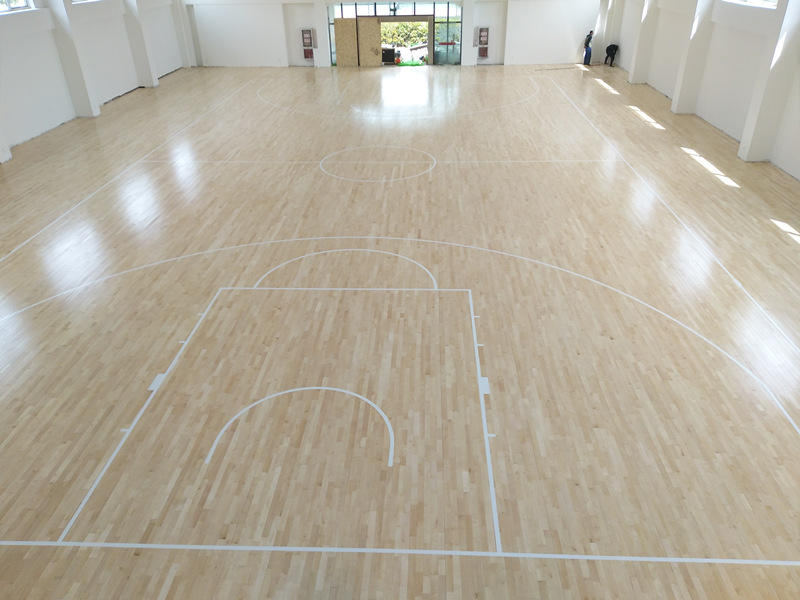
The relationship between an athlete and the floor beneath their feet is more complex than most people realize. Every step, every jump, every change of direction involves a biomechanical interaction with the playing surface. Indoor sports wood flooring is engineered to optimize this interaction, and the science behind it is both fascinating and rigorous.
Let us start with shock absorption. When an athlete lands from a jump, the impact force can be three to five times their body weight. The floor must absorb a portion of this force to protect the joints. Sports wood flooring achieves this through its layered construction. The subfloor system — typically a combination of plywood, foam, or rubber pads — acts as a cushion. The top hardwood layer then distributes the remaining force across a wider area. This two-stage absorption system reduces peak impact forces by 30 to 50 percent compared to rigid surfaces like concrete.
Ball behavior is the next critical factor. In sports like basketball, the ball bounce must be consistent across the entire court. This is measured by a standard called the ball rebound rate. A properly installed sports wood floor will deliver a ball rebound of between 90 and 96 percent of the drop height, depending on the sport. This consistency is achieved through the uniform density of the hardwood and the flatness of the installation. Any deviation in flatness — even a fraction of a millimeter — can cause the ball to behave unpredictably, which is why installation precision is so important.
Traction is perhaps the most nuanced performance variable. Athletes need enough grip to push off, stop, and change direction without slipping. But they also need the floor to release cleanly — too much grip can cause the foot to stick, leading to torque injuries like ACL tears. Sports wood flooring finishes are engineered to hit a very specific friction range. For basketball, the target is typically a DIN friction value between 0.4 and 0.6. This range provides enough grip for safe movement while allowing the foot to release naturally during dynamic actions.
Vertical deformation — how much the floor compresses under load — is another key metric. Sports wood flooring is designed to deform between 2.3 and 4.0 millimeters under a standard test load. This small amount of deflection is what gives the floor its "live" feel. It is enough to reduce impact, but not so much that the surface feels unstable or spongy.
Temperature also matters. Wood is a natural insulator, which means it stays closer to ambient temperature than concrete or synthetic surfaces. This is more comfortable for athletes, especially in facilities without climate control. In cold weather, a wood floor does not become painfully cold to the touch the way concrete does.
All of these factors — shock absorption, ball rebound, traction, deformation, and thermal properties — are the result of careful material selection, precise engineering, and expert installation. Indoor sports wood flooring is not just wood on the ground. It is a high-performance system backed by decades of sports science research.
Leave a Reply