

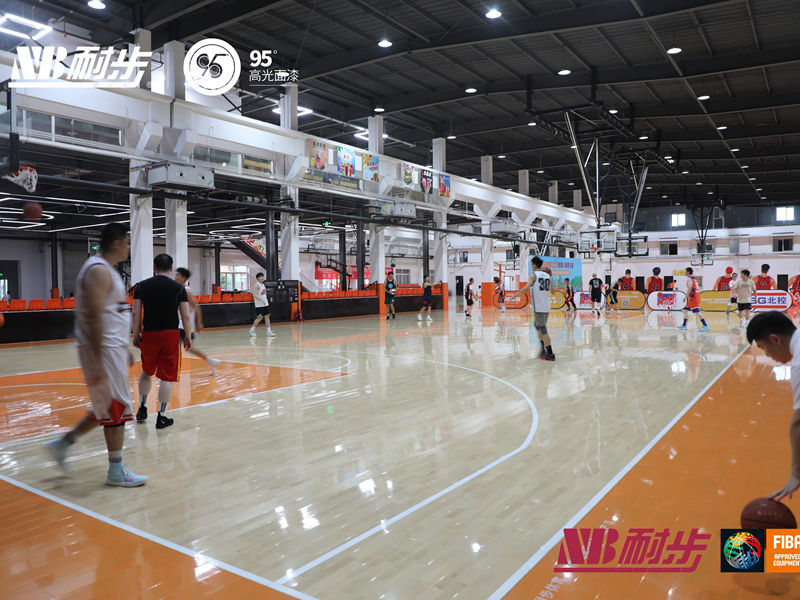
Indoor sports wooden flooring is not simply a piece of wood laid on top of a concrete slab. It is a precisely engineered system designed to optimize athletic performance, protect athletes from injury, and provide a playing surface that meets the strictest international standards. The science behind this flooring is fascinating, and understanding it can help you appreciate why it remains the preferred choice for professional and amateur athletes alike.
At the heart of indoor sports wooden flooring is the concept of force distribution. When an athlete runs, jumps, or lands from a dunk, a tremendous amount of force is exerted on the floor. A standard hardwood floor would transmit nearly all of that force back to the athlete's joints, increasing the risk of injury. Sports wood flooring, however, is designed to absorb and distribute that force across a wider area, significantly reducing the impact on the athlete's body.
This force distribution is achieved through the multi-layer construction of the floor. The top layer of hardwood, typically maple, provides a hard, smooth surface that ensures consistent ball bounce and good traction. Maple is preferred because of its high density (approximately 750 kilograms per cubic meter) and its Janka hardness rating, which measures the resistance of wood to denting and wear. Hard maple has a Janka rating of about 1,450 pounds-force, making it one of the hardest domestic woods available.
Beneath the hardwood surface lies the most critical component for shock absorption: the elastic layer. This layer is usually made from a combination of natural rubber, synthetic polymers, or foam materials. The purpose of this layer is to deform slightly under load, absorbing the kinetic energy generated by athletic movements, and then return to its original shape when the load is removed. The thickness and density of this layer can be adjusted to achieve specific performance targets, such as a target vertical deformation of 2.3 millimeters to 5.3 millimeters, as specified by international sports federations.
The sub-floor layer, typically made from birch plywood or poplar plywood, provides the structural backbone of the entire system. This layer must be extremely flat and stable, as any irregularities will be transmitted through to the playing surface. The plywood is usually laid in a cross-grain pattern to maximize dimensional stability and minimize movement caused by changes in humidity or temperature.
The science of ball bounce is another critical area of engineering. In sports like basketball, the ball bounce must be consistent and predictable. The International Basketball Federation (FIBA) specifies that a basketball dropped from a height of 1.8 meters should bounce back to a height of between 1.2 meters and 1.4 meters. Achieving this level of consistency requires a very flat surface (with a maximum deviation of 2 millimeters over any 3-meter span) and a hardwood surface with specific moisture content (typically between 6% and 10%).
Moisture content is perhaps the single most important variable in the performance of indoor sports wooden flooring. Wood is a hygroscopic material, meaning it absorbs and releases moisture from the surrounding environment. If the moisture content of the flooring is too high, the wood will expand, potentially causing buckling or cupping. If it is too low, the wood will shrink, creating gaps between panels. The ideal moisture content for indoor sports wooden flooring is maintained through a combination of proper acclimatization before installation, climate control within the facility, and the use of moisture barriers during installation.
The finish coat on indoor sports wooden flooring also plays a significant role in performance. The finish must provide enough grip to prevent slipping while not being so sticky that it slows down athletes. Most sports wood floors use a water-based polyurethane finish that is applied in multiple thin coats. The final coat is usually a matte or semi-gloss finish that provides optimal traction without excessive glare.
Temperature also affects the performance of sports wood flooring. Most indoor sports facilities maintain a temperature between 18°C and 24°C, which is ideal for both the wood and the athletes. Extreme temperatures can cause the wood to expand or contract, affecting the flatness and ball bounce of the surface.
In summary, the science behind indoor sports wooden flooring is a complex interplay of material science, biomechanics, and environmental engineering. Every layer, every specification, and every installation detail is carefully calculated to create a playing surface that enhances athletic performance while protecting the health and safety of the athletes who use it.
Leave a Reply