

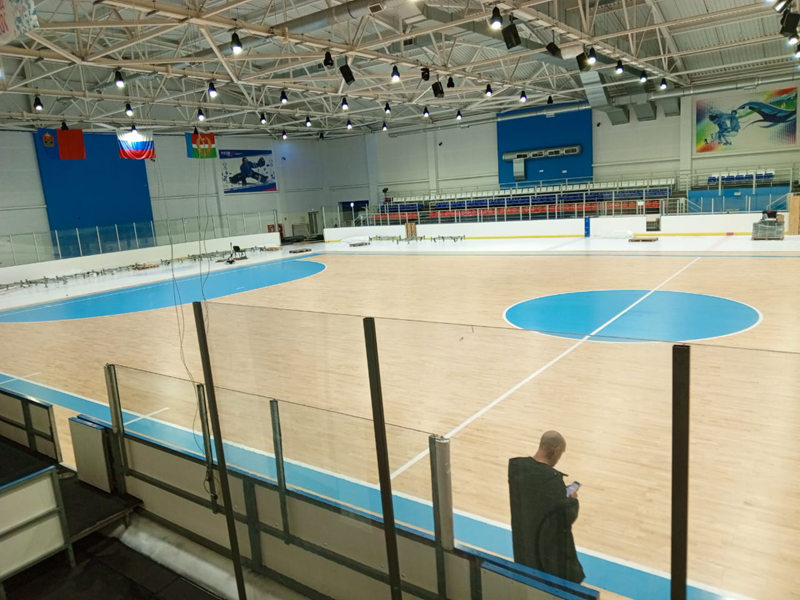
Basketball is a game of inches. A fraction of a second can mean the difference between a made shot and a miss, between a steal and a turnover. The surface on which the game is played plays a crucial role in these razor-thin margins. But what makes a basketball court wood floor truly great? The answer lies in the science of ball bounce, shock absorption, friction, and energy return. In this article, we will dive deep into the physics and engineering behind basketball court wooden flooring.
Ball Bounce: The Most Important Factor
The most critical performance characteristic of any basketball court surface is ball bounce consistency. When a player dribbles the ball, they need to know exactly how high it will bounce and where it will go. Any variation in bounce height or angle can throw off their timing and lead to turnovers.
The ball bounce on a wood floor is governed by several factors:
- Surface Hardness: A harder surface will produce a higher, more consistent bounce. This is why hard maple (Janka 1,450) is preferred over softer woods like pine or fir.
- Surface Smoothness: A smooth, sanded surface ensures that the ball makes even contact, producing a predictable bounce. Any bumps, ridges, or uneven spots will cause the ball to bounce erratically.
- Finish Type: The finish applied to the floor affects how the ball interacts with the surface. A matte finish provides more grip (friction), while a glossy finish allows the ball to slide more easily. Most professional courts use a semi-gloss finish that balances both.
According to FIBA (International Basketball Federation) standards, the ball should bounce to a height of 1,200-1,400 mm (47-55 inches) when dropped from a height of 1,800 mm (71 inches). NBA courts must meet even stricter standards, with a required ball bounce of 1,346-1,473 mm (53-58 inches).
Shock Absorption: Protecting the Players
Basketball is a high-impact sport. Players are constantly running, jumping, landing, and changing direction. Every time a player lands from a jump, their joints absorb a force of 3-5 times their body weight. Over the course of a season, this adds up to thousands of impacts, each one putting stress on the knees, ankles, hips, and spine.
This is where shock absorption comes in. A well-designed basketball court wood flooring system includes a cushioning layer (usually foam or rubber) between the subfloor and the hardwood. This layer absorbs a portion of the impact energy, reducing the force that is transmitted to the player's body.
The standard for shock absorption is measured using the DIN 18032-2 test, which measures the force reduction percentage. FIBA requires a minimum force reduction of 35%, while the NBA requires a minimum of 53%. This means that on an NBA court, the floor absorbs at least 53% of the impact force, significantly reducing the risk of injury.
The cushioning layer is typically 3/4 inch to 1 inch thick and is made from materials such as:
- Polyethylene foam: Lightweight and cost-effective, but may compress over time.
- Polypropylene foam: More durable than polyethylene, with better long-term performance.
- Rubber pads: The most durable option, with excellent shock absorption properties. These are commonly used in professional settings.
Friction: The Grip Factor
Friction, or traction, is what keeps players from slipping when they make a quick cut or come to a sudden stop. Too little friction, and players will slide uncontrollably. Too much friction, and players will feel "stuck" to the floor, making quick movements difficult.
The ideal coefficient of friction for a basketball court is between 0.4 and 0.6. This range provides enough grip for safe, controlled movement while still allowing players to slide when needed.
Friction is affected by:
- Finish type: A matte finish has higher friction; a glossy finish has lower friction.
- Surface texture: A lightly textured surface (achieved through fine-grit sanding) provides better grip than a perfectly smooth surface.
- Moisture and sweat: Sweat on the floor can significantly reduce friction, which is why regular mopping is essential.
- Shoe type: The sole of the player's shoe also affects friction. Most basketball shoes are designed to work optimally on wood floors.
Energy Return: The "Spring" Factor
Energy return refers to how much of the player's energy is returned to them when they push off the floor. A floor with high energy return feels "lively" and responsive, allowing players to jump higher and move faster. A floor with low energy return feels "dead" and can cause fatigue.
Hard maple has excellent energy return properties, which is one reason it is preferred for basketball. The combination of a hard surface and a well-designed cushioning layer creates a floor that is both responsive and protective.
The Role of Climate Control
The performance of a basketball court wood floor is heavily influenced by the environment in which it is installed. Temperature and humidity are the two most important factors:
- Temperature: The ideal temperature for a basketball court is 60-70°F (15-21°C). Temperatures that are too high can cause the wood to expand; temperatures that are too low can cause it to contract.
- Humidity: The ideal relative humidity is 35-50%. Humidity above 60% can cause the wood to absorb moisture, leading to swelling, cupping, and warping. Humidity below 30% can cause the wood to dry out, leading to shrinking, gaps, and cracking.
Professional arenas invest heavily in HVAC systems specifically designed to maintain these conditions. For school and recreational facilities, even basic climate control can make a huge difference in floor performance and longevity.
Conclusion
The science behind basketball court wood flooring is complex and fascinating. Every aspect of the floor — from the species of wood to the thickness of the cushioning layer to the type of finish — is carefully engineered to optimize ball bounce, shock absorption, friction, and energy return. When all these factors are in balance, the result is a surface that enhances the game, protects the players, and delivers an unmatched playing experience.
Leave a Reply