

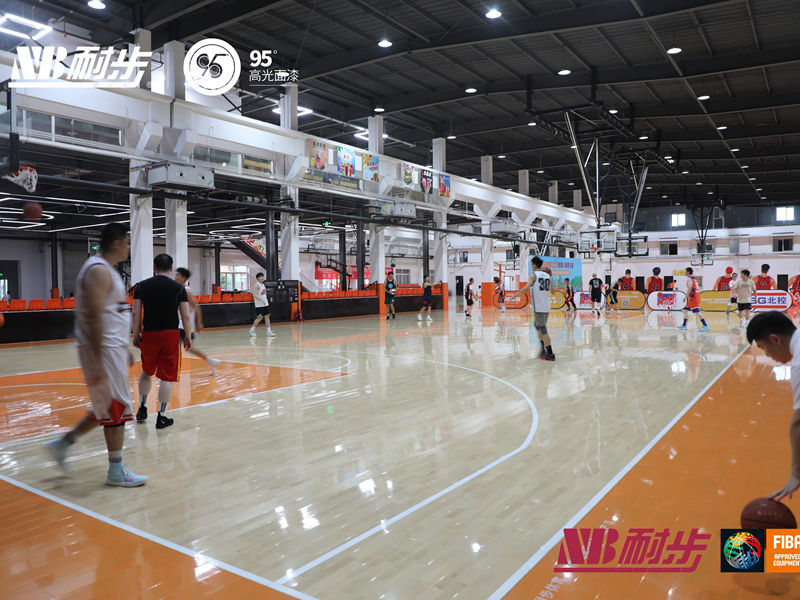
When it comes to choosing the right wood for your basketball court, the decision can feel overwhelming. There are dozens of species to choose from, each with its own unique characteristics, advantages, and disadvantages. However, one species stands head and shoulders above the rest for basketball: hard maple (Acer saccharum). In this article, we will compare hard maple with other popular wood species to help you understand why it is the industry standard — and when you might consider an alternative.
Hard Maple: The King of Basketball Courts
Hard maple has been the wood of choice for professional basketball courts since the 1970s, when the NBA officially adopted it as the standard surface. The reasons are clear:
- Janka Hardness Rating: 1,450 lbf. This means hard maple is extremely resistant to dents, scratches, and wear — exactly what you need for a high-traffic basketball court.
- Fine, Uniform Grain: Hard maple has a very tight, consistent grain pattern that sands beautifully and provides a smooth, even surface. This is critical for ball bounce consistency.
- Light Color: The pale, creamy tone of hard maple makes it easy to see the ball, which is especially important for players. It also creates a bright, professional look.
- Dimensional Stability: Hard maple does not expand or contract significantly with changes in humidity, which means fewer gaps, warps, and other problems over time.
White Oak: The Strong Contender
White oak (Quercus alba) is the second most popular choice for basketball courts. Here's how it compares to hard maple:
| Feature | Hard Maple | White Oak |
|---|---|---|
| Janka Hardness | 1,450 lbf | 1,360 lbf |
| Color | Light, creamy | Medium brown with gray undertones |
| Grain Pattern | Fine, uniform | More pronounced, with ray flecks |
| Ball Bounce | Excellent | Very Good |
| Cost | Higher | Slightly lower |
| Availability | Widely available | Widely available |
White oak is a fantastic choice, especially for facilities that want a slightly different aesthetic. The ray flecks in white oak create a beautiful, distinctive pattern that many people find more visually interesting than maple. However, white oak is slightly less hard than maple, which means it may show wear a bit faster in high-traffic areas.
Red Oak: The Budget-Friendly Option
Red oak (Quercus rubra) is a popular choice for school gymnasiums and recreation centers where budget is a primary concern. Here's how it stacks up:
| Feature | Hard Maple | Red Oak |
|---|---|---|
| Janka Hardness | 1,450 lbf | 1,290 lbf |
| Color | Light, creamy | Pinkish-red to light brown |
| Grain Pattern | Fine, uniform | Open, prominent |
| Durability | Excellent | Good |
| Cost | Higher | Lower |
Red oak is about 10-15% cheaper than hard maple, which can add up to significant savings on a large court. However, the open grain of red oak means it can trap dirt more easily, and it is more prone to denting. For competitive play, red oak is generally not recommended, but for recreational use, it is a perfectly acceptable option.
Other Species Worth Considering
- Bamboo: Bamboo is actually harder than hard maple (Janka rating of 1,380-1,540 lbf depending on the strand) and is incredibly eco-friendly. It has become a popular alternative in recent years, especially for facilities that prioritize sustainability. The downside is that bamboo can feel slightly different underfoot compared to traditional hardwood.
- Beech: European beech is used in many FIBA-sanctioned courts around the world. It is very similar to hard maple in terms of hardness and performance, but it is less commonly available in North America.
- Birch: Birch is another European hardwood that is sometimes used for basketball courts. It is light in color and has a fine grain, but it is not as hard as maple.
- Hickory: Hickory is the hardest domestic wood (Janka rating of 1,820 lbf), but it is rarely used for basketball courts because its grain pattern is very irregular, which can affect ball bounce consistency.
The Verdict
For professional and collegiate basketball, hard maple is the clear winner. Its combination of hardness, uniformity, light color, and dimensional stability makes it the ideal surface for competitive play. For recreational and school settings, white oak is an excellent alternative that offers a beautiful appearance at a slightly lower cost. Red oak is a solid budget option, and bamboo is worth considering for eco-conscious facilities.
No matter which species you choose, the key is to work with a reputable supplier and installer who understands the specific requirements of basketball court flooring.
Leave a Reply