

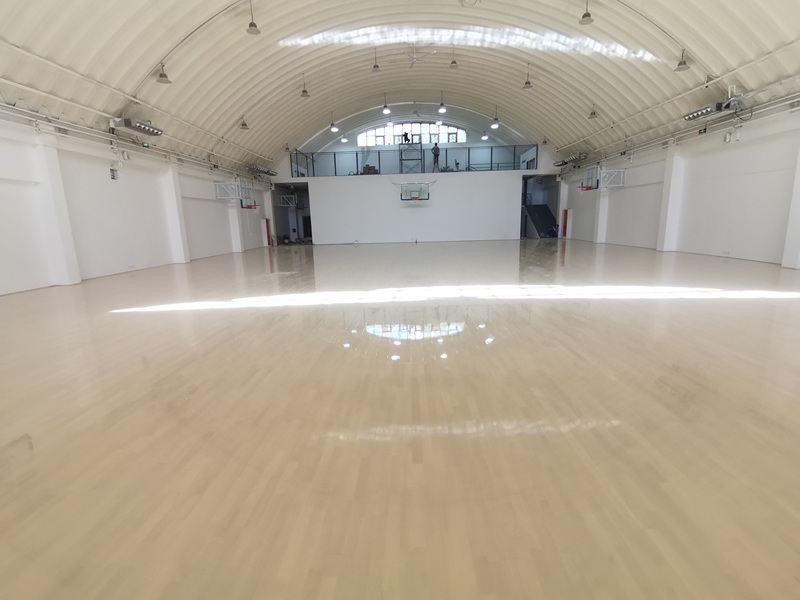
When people think about basketball court flooring, they usually focus on the visible surface: the wood planks, the finish, the court lines. But beneath that surface lies a component that is just as important, if not more so: the subfloor. The quality of subfloor preparation can make or break the performance of the entire court.
The subfloor is the foundation on which the wood flooring is installed. It is typically made of concrete or plywood, and it must meet extremely strict requirements for flatness, strength, and moisture content. If the subfloor is not properly prepared, no amount of quality wood flooring can compensate for the problems that will follow.
Flatness is the most critical requirement. For an indoor basketball court, the subfloor must be level within two millimeters over any three-meter span. This is a very tight tolerance, and achieving it requires careful construction. For concrete subfloors, this often means grinding high spots and filling low spots with a self-leveling compound. For plywood subfloors, it means ensuring that every panel is perfectly flat and that the seams are properly taped and finished.
Strength is the second requirement. The subfloor must be able to support the weight of the wood flooring, the players, the spectators, and any equipment. For concrete, this is rarely an issue, as concrete is extremely strong. For plywood, the panels must be thick enough and properly supported by joists or beams to prevent deflection under load.
Moisture content is the third requirement, and it is often the most overlooked. Wood and moisture do not mix. If the subfloor has a high moisture content, it will transfer moisture to the wood flooring, causing it to swell, cup, and warp. For concrete subfloors, a moisture test must be performed before installation. If the moisture level is too high, a moisture barrier must be installed. This is typically a sheet of polyethylene or a specialized moisture-retardant membrane that is laid over the concrete before the wood flooring is installed.
The underlayment is another important component of subfloor preparation. An underlayment is a layer of material that is placed between the subfloor and the wood flooring. It serves several purposes: it provides additional shock absorption, it helps with moisture management, and it can help correct minor imperfections in the subfloor. Common underlayment materials include foam, rubber, and cork. The choice of underlayment depends on the specific requirements of the court.
Temperature and humidity control in the facility also affect the subfloor. The subfloor should be at the same temperature as the rest of the facility, and the relative humidity should be maintained between 35 and 55 percent. Fluctuations in temperature and humidity can cause the subfloor to expand and contract, which can affect the flatness of the finished floor.
In short, the subfloor is the hidden hero of basketball court flooring. It is the component that you never see, but it is the one that determines whether your court performs well or poorly. Investing in proper subfloor preparation is not an expense; it is an investment in the performance and longevity of your entire court.
Leave a Reply