

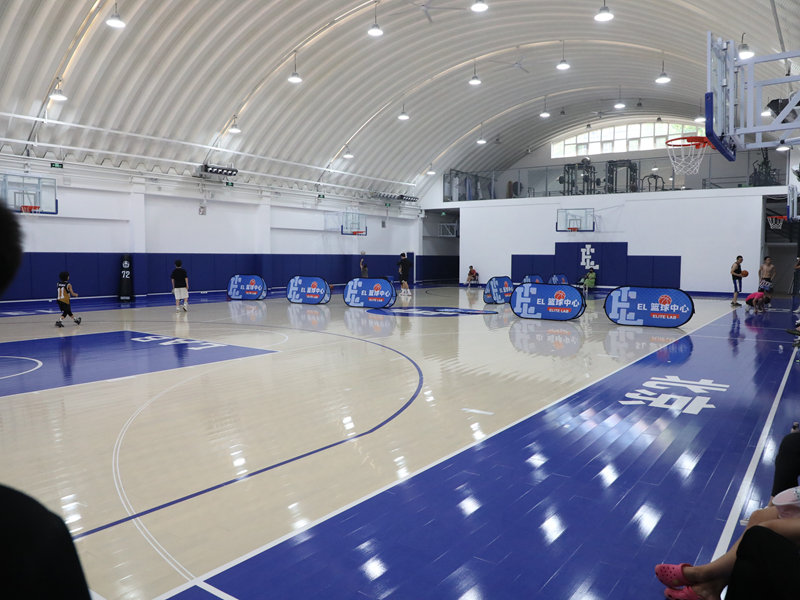
At first glance, indoor basketball court wood flooring looks like a simple, smooth surface made of wooden planks, but beneath that visible top layer lies a complex, multi-layered engineered system that is specifically designed to meet the extreme demands of competitive basketball. A basic low-quality wood floor might just be a layer of planks nailed directly to a concrete slab, but a properly constructed basketball wood flooring system is made up of at least five distinct layers, each with a specific purpose that contributes to the overall performance, safety, and durability of the court. The very bottom layer, sitting directly on the concrete base of the venue, is a set of resilient rubber or foam pads that are precisely spaced across the entire area of the court. These pads are the foundation of the system’s shock absorption: they compress evenly under impact, creating the soft, forgiving feel that protects players’ joints, and they also create a small air gap between the concrete and the rest of the flooring system. This air gap is incredibly important, because it prevents moisture from the cold concrete from seeping up into the wood planks, which would otherwise cause warping, cupping, and mold growth over time.
Above the resilient pads, installers lay a network of wooden sleepers—long, narrow wooden beams that run perpendicular to the direction of the top planks. These sleepers are secured to the pads, creating a stable, level framework that supports the rest of the floor, and the spacing between the sleepers is carefully calculated to ensure that every point on the top surface has consistent support. If the sleepers are spaced too far apart, the wood planks above them will flex too much under a player’s weight, creating weak spots that feel unresponsive; if they are spaced too close together, the floor will be overly firm, eliminating the shock absorption that protects players’ joints. On top of the sleepers, a layer of plywood subfloor is laid down, creating a continuous, uniform base that distributes weight evenly across the entire framework. This subfloor layer also adds extra dimensional stability to the system, preventing the top planks from shifting or warping even when there are significant changes in temperature and humidity inside the venue.
The final two layers of indoor basketball court wood flooring are the visible top wood planks and the protective finish system. The top planks are laid at a 90-degree angle to the plywood subfloor, secured with specialized fasteners that allow the wood to expand and contract naturally with changes in moisture without pulling away from the subfloor. Once the planks are all in place, they are sanded multiple times with progressively finer grits of sandpaper to create a perfectly smooth, completely level surface where there are no bumps, ridges, or uneven spots that could disrupt a player’s movement. Finally, multiple coats of a specialized athletic finish are applied, with light sanding between each coat to create a strong, durable surface that has just the right amount of traction. Every single layer in this system works together to create a surface that is far more than just wood on concrete: it is a precision-engineered athletic platform that balances shock absorption, stability, traction, and durability to create the ideal playing environment for basketball. This layered design is the reason that high-quality indoor basketball court wood flooring can last for decades, even under the heaviest levels of competitive play.
Leave a Reply