

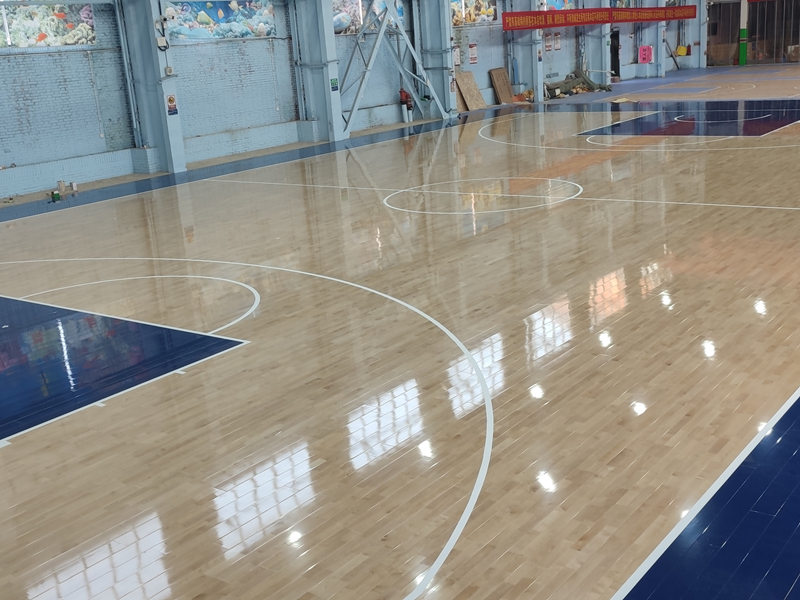
The top playing surface of indoor basketball court wood flooring is the part that players interact with directly, and the choice of wood species for this layer has an enormous impact on the performance, durability, and feel of the entire court. Different hardwood species have unique physical properties—density, grain pattern, shock resistance, and coefficient of friction—that make them more or less suitable for the intense demands of basketball play, and selecting the right species is one of the most important decisions when designing a new court. One of the most widely used species for indoor basketball court wood flooring around the world is a dense, tight-grained hardwood that offers exceptional resistance to impact and abrasion. Its uniform grain structure means that it wears down very slowly and evenly, even under the constant friction of basketball shoe soles, and its high density prevents deep scuffs and dents from forming when heavy equipment is dragged across the surface or when players drop heavy weights during pre-game warmups. This species also has a consistent natural texture that holds finish very well, maintaining a reliable level of traction over long periods of regular play without becoming overly smooth or slippery.
Another popular choice for indoor basketball court wood flooring top layers is a slightly more flexible hardwood that offers a warmer, more responsive feel underfoot. This species has a slightly lower density than the hardest options, which gives it a little more natural give that complements the shock absorption of the underlying flooring system, creating a uniquely soft and forgiving playing experience that many professional players prefer. Its distinct, visible grain pattern also creates a beautiful, classic visual look that gives the court a timeless, high-quality aesthetic, making it a popular choice for venues that want a traditional, premium feel. This species does require a little more careful maintenance than the densest options, however, as its slightly softer surface is more prone to scuffs if heavy objects are dragged across it without proper protection, but when cared for correctly, it can still last for decades of regular play. A third common option is a very hard, highly durable hardwood that is often selected for high-traffic community centers and school gyms that host multiple sports and events throughout the week. This species is almost immune to dents and scuffs, making it nearly indestructible even under heavy, constant use, though it does have a firmer, less forgiving feel than the more flexible options.
Each of these wood species brings unique strengths to indoor basketball court wood flooring, and the right choice depends entirely on the specific needs of the venue. A professional arena that hosts only basketball games and high-level competitions can prioritize the responsive, forgiving feel of a slightly softer species, while a multi-use community gym that hosts basketball, volleyball, badminton, and large community events will benefit far more from the extreme durability of the densest, most scratch-resistant option. What all high-quality wood species for basketball courts share, however, is a tight, consistent grain structure, a high level of dimensional stability that minimizes warping, and the ability to hold a finish evenly to create a consistent traction surface across every inch of the court. No matter which species is chosen, the top layer of indoor basketball court wood flooring forms the direct connection between the player and the game, making its properties one of the most critical factors in the quality of the playing experience.
Leave a Reply