

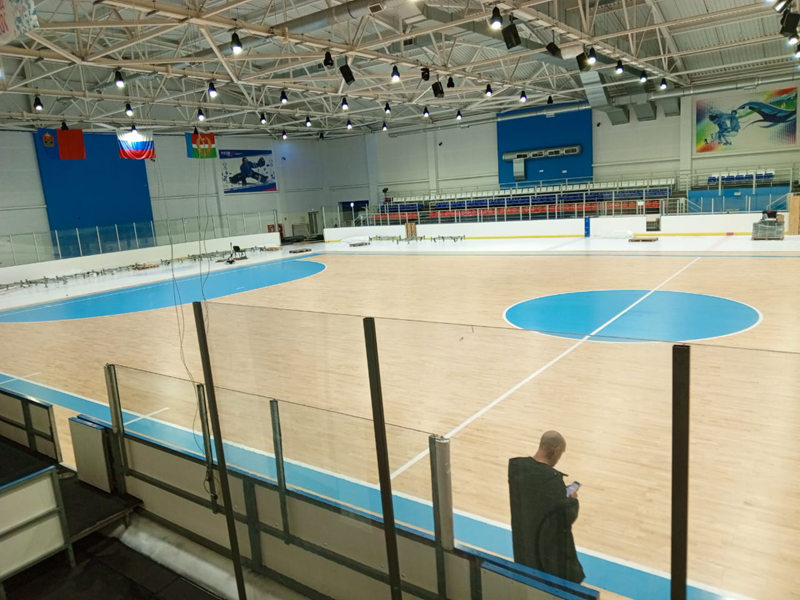
The story of indoor basketball court wood flooring is deeply intertwined with the history of basketball itself, evolving alongside the sport from its earliest informal gymnasium beginnings to the highly engineered competitive surfaces we see in modern arenas today. When basketball was first invented in the late 19th century, the game was played on a wide variety of makeshift surfaces: packed dirt, rough wooden gym floors that were originally designed for dance or general exercise, and even polished concrete in some early community centers. These early surfaces were inconsistent, often slippery, and offered no protection for players, leading to frequent injuries that limited how fast the sport could grow. As basketball gained popularity in the early 20th century, venue organizers began to experiment with dedicated wood flooring systems specifically designed for the sport, using long, solid wood planks laid directly over wooden subframes to create a smoother, more stable playing surface. These early generations of indoor basketball court wood flooring were a massive improvement over previous options, but they still had significant flaws: they would warp dramatically with changes in humidity, develop dangerous gaps between planks, and offer almost no shock absorption, leaving players with sore legs after every game.
The mid-20th century marked a major turning point in the evolution of indoor basketball court wood flooring, as engineers began to study the specific biomechanical needs of basketball players and develop layered systems that addressed the flaws of older solid plank designs. The introduction of resilient rubber pads beneath the wood substructure was the biggest breakthrough of this era, adding a new level of shock absorption that had never been possible before. This innovation transformed the player experience, turning the previously hard, unforgiving wood floors into surfaces that felt springy and forgiving underfoot, while still maintaining the stability that players needed for fast movement. During this period, venue operators also began to standardize the types of wood used for the top playing surface, moving away from random local hardwood species and selecting denser, more consistent varieties that could stand up to thousands of hours of heavy foot traffic without wearing down unevenly. The finish systems also evolved during this time, moving from simple wax coatings that needed to be reapplied every few weeks to more durable polyurethane finishes that could maintain consistent traction for months at a time.
In the last 30 years, indoor basketball court wood flooring design has advanced even further, incorporating precision engineering, computer-aided moisture testing, and modular installation systems that create far more consistent and durable surfaces than ever before. Modern systems no longer rely on one-size-fits-all designs; instead, they can be customized for the specific use case of the venue, with different levels of shock absorption for youth recreational centers, competitive high school gyms, and professional arenas. Engineers have also developed new ways to control the movement of the wood as it expands and contracts with changes in temperature and humidity, eliminating the warping and gapping issues that plagued older wood floors for generations. Today’s indoor basketball court wood flooring systems are the product of more than a century of trial, error, and careful study, refined by millions of players and thousands of venue operators to create a surface that perfectly balances performance, safety, and durability. This long evolutionary journey shows that the wood court is not just a static piece of venue infrastructure—it is a constantly improving technology that has grown right alongside the sport of basketball.
Leave a Reply