

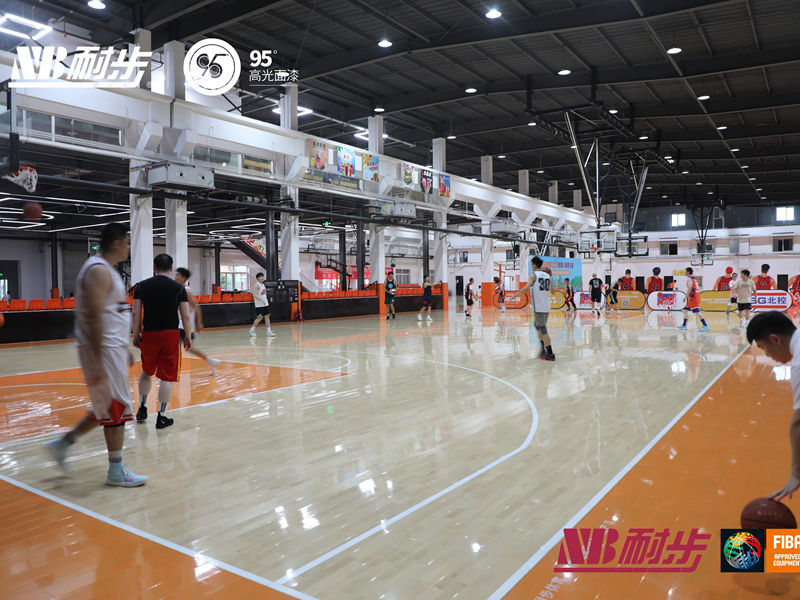
When facility managers and sports organizations evaluate flooring options, modular sports wood flooring consistently emerges as the preferred choice for a wide range of indoor applications. The advantages are not merely incremental improvements over traditional systems — they represent a fundamental shift in how sports floors are designed, installed, maintained, and even reused.
The most immediately apparent advantage is installation speed. A traditional sports wood floor requires skilled labor to glue, nail, and sand each plank individually, a process that can take weeks or even months for a full-sized gymnasium. Modular systems, by contrast, can be installed by a smaller crew in a fraction of the time. Because the panels lock together mechanically, there is no curing time for adhesives and no need for extensive sanding and finishing on-site. For facilities that need to open quickly or that operate on tight construction schedules, this speed advantage is invaluable.
Equally important is the disassembly and relocation capability. Traditional floors are essentially permanent fixtures. Once installed, removing them is destructive, expensive, and time-consuming. Modular floors can be taken apart panel by panel, transported to a new location, and reassembled with minimal loss of performance. This is particularly valuable for schools that share facilities between sports, for organizations that move between venues, and for event companies that need to create temporary competition spaces.
Maintenance is another area where modular systems shine. Because each panel is independent, a damaged section can be swapped out without disturbing the surrounding floor. In a traditional system, a single damaged board might require cutting out a large section, patching the subfloor, and refinishing the entire area to match. With modular flooring, you simply unlock the damaged panel, replace it with a new one, and lock it back in. This reduces both downtime and long-term maintenance costs significantly.
Cost efficiency over the lifecycle of the floor is perhaps the most compelling argument. While the upfront cost of modular systems can be comparable to or slightly higher than traditional installations, the total cost of ownership is often lower. Faster installation means lower labor costs. Easier maintenance means fewer service calls. The ability to relocate means the floor retains its value even if the facility changes. And the longer usable lifespan — thanks to the ability to replace individual panels — means the floor serves the organization for more years.
Performance consistency is another advantage that should not be overlooked. Modular panels are manufactured in controlled factory conditions, ensuring uniformity in thickness, flatness, and surface quality. This consistency translates to predictable ball bounce, even shock absorption, and reliable friction characteristics across the entire floor surface. Traditional hand-installed floors can suffer from variations in plank height and surface finish, which affect playing conditions.
Finally, modular sports wood flooring offers environmental benefits. The ability to disassemble and reuse panels reduces waste. Hardwood panels can be refinished multiple times, extending their useful life. And when a floor is no longer needed in one location, it can find a second life in another, rather than ending up in a landfill.
These advantages collectively make modular sports wood flooring not just an alternative to traditional systems, but in many cases, a clearly superior solution.
Leave a Reply