

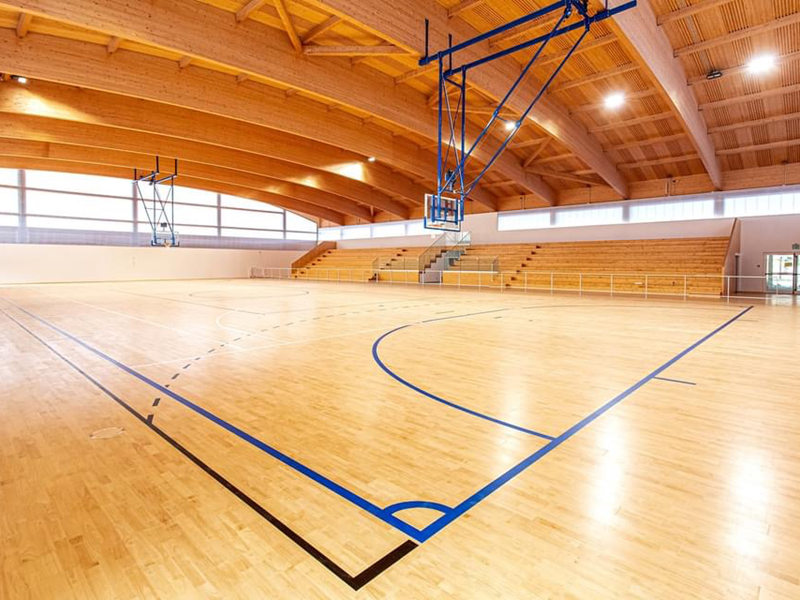
Modular indoor sports wood flooring, also known as detachable or assembly-type sports wood flooring, represents one of the most practical and versatile solutions available today for gymnasiums, training centers, multi-purpose halls, and even residential sports rooms. Unlike traditional fixed-installation wood flooring that is permanently glued or nailed to the subfloor, modular systems are engineered to be assembled, disassembled, relocated, and reinstalled with relative ease.
At its core, a modular sports wood floor consists of individual floor panels — typically made from hardwood species such as maple, oak, or beech — that are manufactured with precision-milled locking mechanisms on all four sides. These interlocking connections allow each panel to snap into place without the need for adhesives, nails, or screws during installation. Beneath the visible wood surface, each panel sits on a specialized support structure that may include rubber pads, spring mounts, or foam underlayment, depending on the performance requirements of the space.
The concept of modularity extends beyond just the panels themselves. The entire flooring system — including the subframe, shock absorption layer, and surface panels — is designed as a cohesive unit that can be treated almost like a large-scale puzzle. This means that if a section of the floor becomes damaged, only that specific section needs to be replaced rather than the entire floor. It also means that the floor can be moved from one venue to another, making it an excellent investment for organizations that operate in temporary or evolving spaces.
One of the defining characteristics of modular sports wood flooring is its compliance with international sports standards. Organizations such as DIN, EN, and FIBA have established specific requirements for ball bounce, shock absorption, and surface friction, and reputable modular systems are tested and certified to meet or exceed these benchmarks. This ensures that athletes performing on these floors experience consistent, predictable performance regardless of where the floor is installed.
The rise of modular sports flooring has been driven by several market forces. Schools and universities need floors that can serve multiple sports and be reconfigured for different events. Community centers want cost-effective solutions that can be upgraded over time. Professional training facilities demand high performance without the permanence of a traditional installation. And event organizers appreciate the ability to set up a competition-grade floor in a convention hall and take it down afterward.
Understanding modular indoor sports wood flooring starts with recognizing that it is not simply a type of wood floor — it is a complete engineered system designed for athletic performance, durability, and flexibility. Whether you are a facility manager, an architect, a coach, or a sports enthusiast building a home court, knowing what modular flooring is and how it works is the first step toward making the right flooring decision.
Leave a Reply