

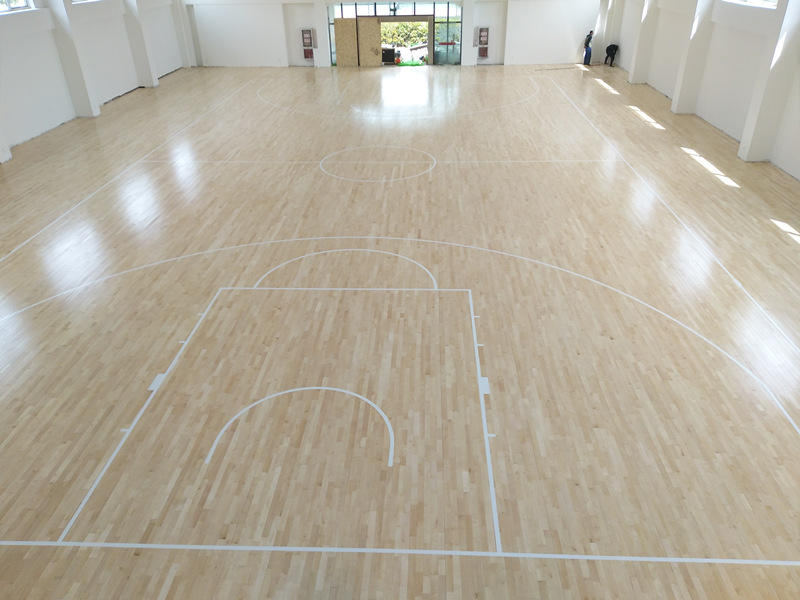
Installing modular indoor sports wood flooring is a structured process that, while requiring precision, is significantly more straightforward than installing a traditional glued-down wood floor. Understanding each step helps facility managers set realistic expectations, allocate resources properly, and ensure the final result meets performance standards.
The process begins with subfloor preparation. The existing concrete or wood subfloor must be clean, dry, level, and structurally sound. Any cracks, uneven spots, or moisture issues must be addressed before the modular system is laid. A leveling compound may be applied if the subfloor has minor variations, but the goal is to achieve a flat surface with minimal deviation — typically no more than two millimeters over a two-meter span. This is critical because modular panels rely on their locking mechanisms for stability, and an uneven subfloor will cause gaps, uneven surfaces, and performance issues.
Once the subfloor is ready, the shock absorption layer is installed. This is one of the most important components of any sports floor system. The shock absorption layer — which may consist of rubber pads, spring mounts, foam blocks, or a combination — is placed according to the manufacturer's specifications. This layer is responsible for reducing the impact forces transmitted to athletes' joints and for meeting the shock absorption requirements set by sports governing bodies. The placement must be precise; incorrect positioning can lead to inconsistent performance across the floor.
Next, the support frame or batten system is installed. This framework provides the structural base on which the wood panels will sit. In many modular systems, the battens are adjustable, allowing fine-tuning of the floor's level and stiffness. The battens are typically spaced at regular intervals and secured to the subfloor through the shock absorption layer.
With the substructure complete, the modular wood panels are laid. Starting from one corner of the room, panels are placed in a staggered pattern — similar to bricklaying — to ensure structural stability and even load distribution. Each panel is aligned with its neighbors, and the locking mechanisms on all four sides are engaged. No glue, nails, or screws are used to connect the panels to each other. The panels simply rest on the batten system and are held in place by their own weight and the friction of the locking joints.
After all panels are in place, the floor is inspected for levelness, gaps, and consistency. Any panels that sit slightly high or low are adjusted by shimming the battens beneath them. The surface is then cleaned to remove any dust or debris from the installation process.
The final step is the application of sports floor paint or finish, if required. Many modular systems come with a pre-finished surface, but some require on-site finishing to achieve the desired friction and appearance. The finish must be applied evenly and allowed to cure fully before the floor is used for sports.
The entire installation process, for a standard gymnasium, can typically be completed in five to ten days with a crew of four to six workers — a dramatic improvement over the four to eight weeks often required for traditional installation.
Leave a Reply