

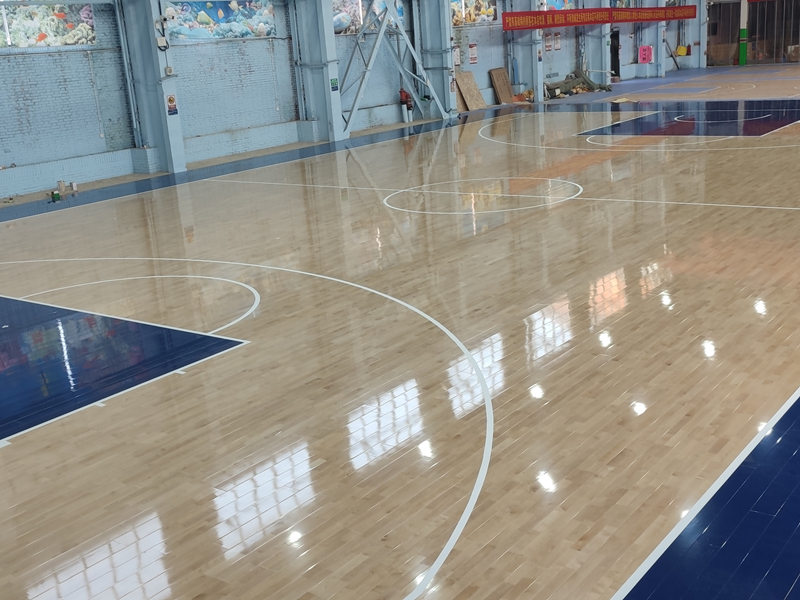
The installation of indoor sports wooden flooring is a precise, multi-stage process that requires skilled labor, specialized equipment, and strict adherence to technical standards. A poorly installed floor will warp, buckle, develop gaps, and fail to meet performance requirements. Understanding the installation process helps facility owners appreciate why professional installation is non-negotiable.
The first stage is subfloor preparation. This is arguably the most important step in the entire process. The subfloor must be completely flat, clean, dry, and structurally sound. For concrete subfloors, this means grinding down any high spots, filling any low spots with self-leveling compound, and ensuring the surface is free of dust, oil, and moisture. The flatness tolerance is typically no more than two millimeters over a two-meter span. Any deviation beyond this will cause the finished floor to feel uneven and may lead to premature wear.
For wooden subfloors, the preparation is different. The existing wood must be inspected for rot, loose boards, and structural weakness. Any damaged sections must be replaced. The subfloor must also be completely dry, with a moisture content below 12 percent. Moisture testing is done with a calibrated moisture meter, and readings must be consistent across the entire area.
The second stage is acclimatization. The wood flooring material must be brought into the facility and left to acclimate to the local temperature and humidity for a minimum of 48 to 72 hours. This allows the wood to reach equilibrium with its environment. Skipping this step is one of the most common causes of installation failure, as wood that is not properly acclimatized will expand or contract after installation, causing gaps, cupping, or buckling.
The third stage is laying the elastic layer. This is the shock-absorption component of the system. It typically consists of rubber pads, foam mats, or a combination of both, placed directly on the subfloor. The thickness and density of this layer are critical for achieving the required shock absorption values. The pads must be laid in a precise pattern, often with staggered joints to avoid creating weak points. In some systems, the elastic layer is integrated into the flooring panels themselves.
The fourth stage is installing the flooring panels or planks. For solid hardwood, individual planks are laid in a staggered pattern, usually perpendicular to the direction of the primary subfloor joists. For engineered wood or parquet, pre-manufactured panels are laid in a specific pattern. Each piece must be precisely aligned, and the gaps between pieces must be uniform, typically between three and five millimeters to allow for seasonal expansion. The flooring is either glued down, floating, or mechanically fastened, depending on the system.
The fifth stage is sanding. After the flooring is installed, the entire surface is sanded to create a perfectly flat, smooth playing surface. This is done with large industrial sanding machines that remove a thin layer from the top of the wood. The sanding process also opens the wood grain, which helps the finish adhere better. Multiple passes with progressively finer grit paper are used, typically starting at 60 grit and finishing at 100 or 120 grit.
The sixth stage is finishing. The floor is coated with a specialized sports finish, usually a water-based polyurethane. Between five and ten coats are applied, with light sanding between each coat to ensure a smooth, even surface. Each coat must be allowed to dry completely before the next is applied. The total drying time for the finish can take several days to over a week, depending on the number of coats and the ambient conditions.
The final stage is line marking and final inspection. Court lines, logos, and other markings are painted or applied using stencils. The completed floor is then tested for ball rebound, shock absorption, and slip resistance to verify that it meets all performance standards.
Every stage of this process demands expertise. Cutting corners at any point will compromise the entire system.
Leave a Reply