

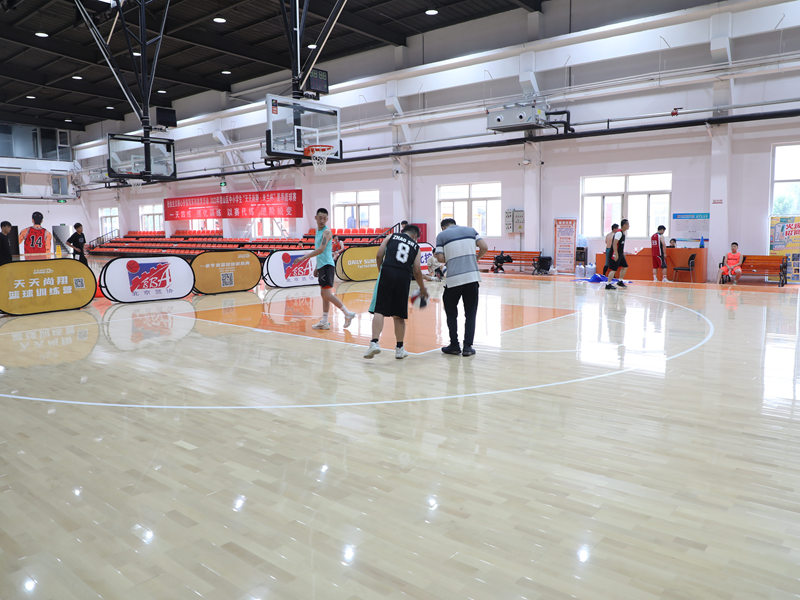
The Solution: Hybrid Systems
Hybrid floors combine a hardwood basketball playing surface with a synthetic or cushioned surround:
| Hybrid Type | Description | Use Case |
|---|---|---|
| Hardwood Center + Synthetic Surround | Hard maple in the key and three-point area; synthetic tiles on the sidelines | Multi-sport gymnasiums |
| Hardwood + Removable Synthetic Overlay | Full hardwood court with a snap-on synthetic layer for non-basketball events | Community centers, schools |
| Engineered Hybrid Planks | Planks with a hardwood top layer and a synthetic core | Training facilities |
The Impact:
Hybrid systems allow facilities to have a professional basketball court without sacrificing versatility. They are the fastest-growing segment of the market.
Prediction: Hybrid systems will account for 25% of all new court installations by 2030.
Trend 4: Sustainable and Bio-Based Materials
Beyond FSC Certification
The next wave of sustainability goes beyond certified wood:
| Innovation | Description | Status |
|---|---|---|
| Bio-Based Polyurethane | Finish made from plant-based oils instead of petroleum | Commercially available (Bona, Loba) |
| Bamboo Hardwood | Engineered bamboo planks with hardness comparable to maple | Available, growing in popularity |
| Mycelium Composites | Sub-floor material made from mushroom root structures | Research stage |
| Carbon-Negative Wood | Wood sourced from forests that sequester more carbon than they release | Emerging |
The Impact:
By 2030, the majority of new hardwood courts will use bio-based finishes, and bamboo will be a mainstream alternative to maple.
Prediction: Bamboo basketball court floors will capture 10% of the market by 2030.
Trend 5: Climate-Adaptive Flooring
The Challenge:
Climate change is creating more extreme temperature and NBA's global popularity
- Social media culture (players filming games at home)
- Rising real estate values (a basketball court adds 50,000–100,000 to home value)
What Homeowners Want:
| Feature | Demand Level |
|---|---|
| Hard maple finish | ★★★★★ |
| Portable/removable system | ★★★★☆ |
| Easy DIY installation | ★★★★★ |
| Under $10,000 total cost | ★★★★☆ |
| NBA-quality feel | ★★★☆☆ |
The Future:
Manufacturers are responding with:
- Click-lock hardwood systems that homeowners can install in a weekend
- Portable hardwood panels that roll up and store in a garage
- Subscription-based maintenance services (companies that come to your house to sand and refinish)
Prediction: The home basketball court market will grow 20% annually through 2030, reaching $2 billion globally.
The Big Picture: Where Is Basketball Court Flooring Headed?
| Timeline | Key Development |
|---|---|
| 2025–2027 | Nano-coatings become mainstream; smart floors in 20% of new arenas |
| 2027–2030 | Hybrid systems dominate multi-sport facilities; bamboo floors gain traction |
| 2030–2035 | Climate-adaptive sub-floors become standard; 3D-printed sub-floors enter professional market |
| 2035–2040 | Fully integrated smart courts with AI-powered maintenance; carbon-negative floors |
Conclusion
The future of basketball court hardwood flooring is incredibly exciting. From smart sensors embedded in the wood to nano-coatings that make the floor virtually indestructible, the next generation of courts will be smarter, greener, more durable, and more versatile than ever before. But at the core of it all will still be the same thing that has made hardwood the gold standard for over a century: the perfect ball bounce, the perfect grip, and the perfect feel. Technology will enhance the hardwood experience — but it will never replace it. The hardwood floor is not just the foundation of the game. It is the game.
Leave a Reply