

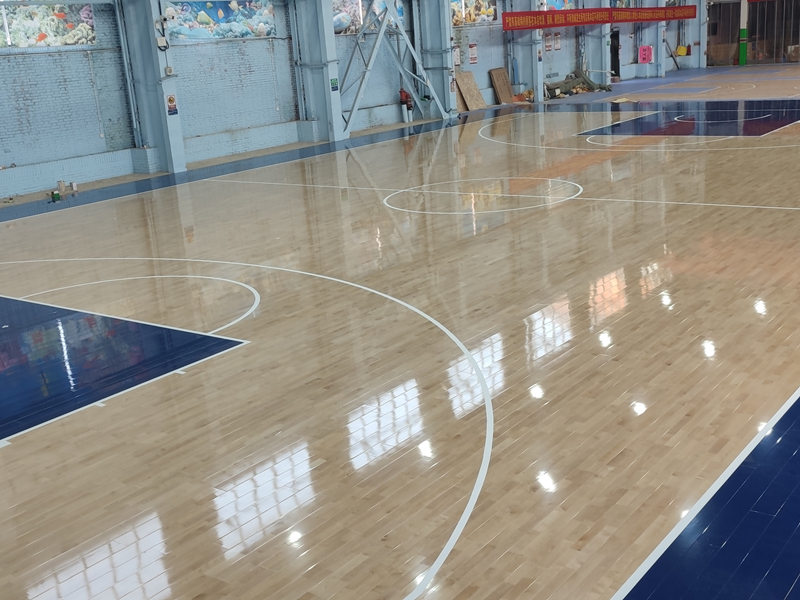
As the world becomes more environmentally conscious, every building material is under scrutiny—including gymnasium wooden flooring. Is hardwood flooring sustainable? What's the carbon footprint of a gymnasium floor? Are there greener alternatives?
In this article, we'll examine the environmental impact of gymnasium wooden flooring from forest to gymnasium, and explore the innovations making this industry more sustainable than ever.
The Carbon Footprint of a Gymnasium Floor
Let's start with the numbers. A typical 5,000 square foot maple gymnasium floor (including subfloor, shock pad, adhesive, and finish) has an estimated carbon footprint of:
- Wood (maple): Approximately 1.5-2.5 kg CO2 per square foot (including harvesting, milling, and transportation)
- Plywood subfloor: 0.5-1.0 kg CO2 per square foot
- Shock pad (rubber): 1.0-2.0 kg CO2 per square foot (synthetic rubber is petroleum-based)
- Adhesive: 0.2-0.5 kg CO2 per square foot
- Finish (polyurethane): 0.1-0.3 kg CO2 per square foot
- Installation labor and equipment: 0.5-1.0 kg CO2 per square foot
Total: approximately 4-7 kg CO2 per square foot, or 20,000-35,000 kg (22-39 tons) for a 5,000 sq ft gym.
For context, the average car emits about 4.6 tons of CO2 per year. A gymnasium floor represents roughly 5-8 years of car emissions.
The Wood Itself: Renewable but Not Infinite
The good news: wood is a renewable resource. Trees absorb CO2 as they grow, and when harvested responsibly, new trees replace them, creating a carbon-neutral cycle.
A mature hardwood tree sequesters approximately 48 pounds of CO2 per year. It takes 60-100 years for a maple tree to reach harvestable size (12+ inch diameter). During that time, it has sequestered 2,880-4,800 pounds of CO2.
When that tree is milled into flooring and installed in a gymnasium, the carbon remains stored in the wood for the life of the floor—potentially 40-50 years. In effect, a gymnasium floor is a carbon sink—it's storing carbon that would otherwise be in the atmosphere.
This is a significant advantage over synthetic flooring materials (vinyl, rubber, polypropylene), which are petroleum-based and release their stored carbon when manufactured and eventually when disposed of.
The Problem: Deforestation and Overharvesting
The sustainability story isn't entirely positive. North American hard maple has been overharvested for decades. The sugar maple population has declined significantly in the northeastern United States due to:
- Acid rain: Weakens trees and makes them susceptible to disease
- Climate change: Shifts suitable growing ranges northward
- Pests and disease: Asian longhorned beetle, tar spot fungus, and other threats
- Development: Forest land converted to housing and agriculture
The result: maple prices have tripled in the past 15 years, and supply is increasingly uncertain.
Certification and Responsible Sourcing
To address these concerns, the gymnasium flooring industry has embraced certification programs:
FSC (Forest Stewardship Council)
The most widely recognized certification. FSC-certified forests must meet strict environmental, social, and economic standards. Approximately 30-40% of gymnasium flooring wood is now FSC-certified.
SFI (Sustainable Forestry Initiative)
A North American certification program that's gaining popularity. SFI-certified forests must maintain forest health, wildlife habitat, water quality, and worker safety.
PEFC (Programme for the Endorsement of Forest Certification)
A global certification system that recognizes national forest certification programs.
When specifying gymnasium flooring, always ask for FSC or SFI certification. Reputable suppliers will have this documentation readily available.
The Shock Pad Problem
While the wood itself is sustainable, the shock pad is often the weakest link in the environmental chain. Most gymnasium shock pads are made from:
- SBR rubber: Petroleum-based synthetic rubber. Manufacturing releases volatile organic compounds (VOCs) and consumes significant energy.
- Neoprene: Also petroleum-based, with additional environmental concerns during production.
However, there are greener alternatives:
Recycled Rubber Shock Pads
Made from recycled tires, these pads divert waste from landfills and reduce petroleum consumption. Companies like Harvest International and Rebound Ace offer recycled rubber options that perform comparably to virgin rubber.
Natural Rubber
Harvested from rubber trees (Hevea brasiliensis), natural rubber is renewable and biodegradable. However, natural rubber plantations have their own environmental concerns (deforestation in Southeast Asia, pesticide use).
Cork
A highly sustainable material harvested from cork oak bark (the tree isn't cut down). Cork provides excellent shock absorption and is completely natural and biodegradable.
Recycled Foam
Some manufacturers now produce shock pads from recycled polyethylene foam, reducing both waste and petroleum use.
Finishes and Adhesives: The Hidden Environmental Costs
The finish and adhesive layers, while thin, can have outsized environmental impacts:
Water-based polyurethane is the greenest finish option—low VOC, low toxicity, easy to clean up with water. Many manufacturers now offer water-based systems specifically for gymnasiums.
UV-cured finishes have near-zero VOC emissions (they cure instantly with UV light rather than evaporating solvents), making them excellent from an air quality perspective. However, the UV equipment consumes significant energy.
Low-VOC adhesives are now standard in the industry. Urethane-based adhesives with less than 50 g/L VOC are widely available and perform well in gymnasium applications.
End of Life: What Happens to the Floor?
One of the greatest environmental advantages of wood flooring is its end-of-life options:
- Refinishing: Extends the life of the floor, delaying disposal. A maple floor can be refinished 6-10 times.
- Reuse: Old gymnasium planks can be repurposed as wall paneling, furniture, or decorative elements.
- Recycling: Wood can be chipped and used as mulch, biomass fuel, or engineered wood products.
- Composting: Pure wood (without finish) is biodegradable and can be composted.
In contrast, synthetic flooring (vinyl, rubber) typically ends up in landfills, where it can take hundreds of years to decompose and may release toxic chemicals.
Carbon Sequestration: The Hidden Benefit
Here's a calculation that puts the sustainability of wood flooring in perspective:
A 5,000 sq ft maple gymnasium floor uses approximately 3,000 board feet of maple lumber. A board foot of maple weighs about 3.75 pounds and is approximately 50% carbon by dry weight.
That means the floor stores approximately:
3,000 bf × 3.75 lbs × 0.50 carbon × 0.44 (carbon to CO2 conversion) = 2,475 lbs of CO2 (1.12 tons)
Over a 40-year lifespan, that's the equivalent of taking a car off the road for about 3 months—just from the wood alone. Add the carbon stored in the plywood subfloor, and the total is even higher.
Innovations in Sustainable Gymnasium Flooring
The industry is moving fast on sustainability:
- Bamboo flooring: Grows 3-5 years to harvest vs. 60-100 years for maple. Extremely hard and durable.
- Cork flooring: Fully renewable, excellent shock absorption, naturally antimicrobial.
- Bio-based adhesives: Made from soy, corn, or other plant-based materials instead of petroleum.
- Carbon-neutral manufacturing: Some companies are offsetting their manufacturing emissions through reforestation projects.
- Modular floor systems: Designed for easy disassembly and reuse, reducing waste at end of life.
Conclusion
Gymnasium wooden flooring is one of the more environmentally responsible building materials available—when sourced and installed correctly. It stores carbon, is renewable, can be refinished multiple times, and is fully recyclable or biodegradable at end of life.
The key to maximizing the environmental benefits is:
- Choose FSC/SFI-certified wood
- Specify recycled or natural rubber shock pads
- Use water-based or UV-cured finishes
- Maintain the floor properly to maximize lifespan
- Plan for reuse or recycling at end of life
By making these choices, you can have a beautiful, high-performance gymnasium floor that's also good for the planet.
Leave a Reply