

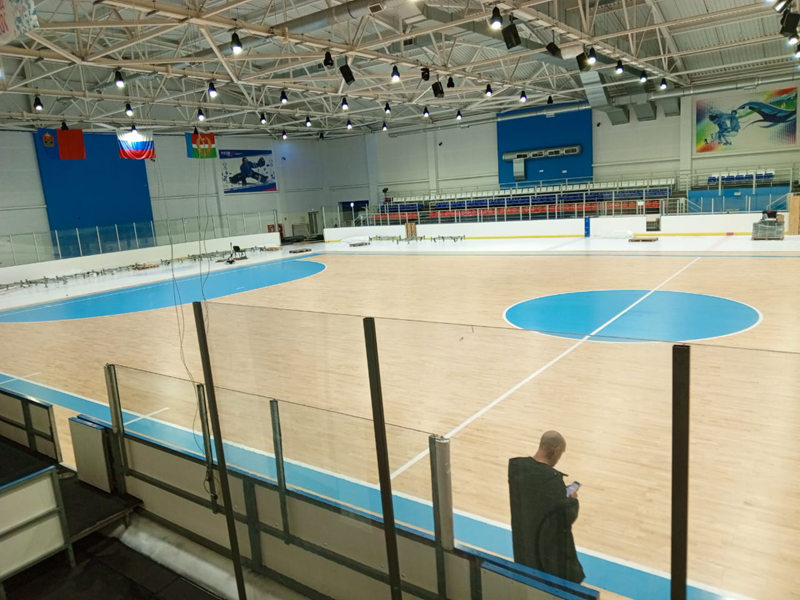
Installing a gymnasium wooden floor is one of the most precise and demanding construction tasks in the building industry. A poorly installed floor can lead to squeaks, gaps, uneven surfaces, premature wear, and even structural damage. A properly installed floor will perform beautifully for decades.
This step-by-step guide covers the complete installation process for a standard floating hardwood gymnasium floor, from subfloor preparation to final finishing.
Phase 1: Planning and Preparation (Weeks 1-4 Before Installation)
Step 1: Environmental Conditioning
Wood is hygroscopic—it absorbs and releases moisture based on the surrounding environment. Before installation, both the wood flooring and the building must be conditioned to the same temperature and humidity.
- Bring wood planks into the building at least 48-72 hours before installation
- Maintain indoor temperature at 65-80°F (18-27°C)
- Maintain relative humidity at 40-60%
- The wood should reach equilibrium moisture content (EMC) of 6-9% before installation
Failure to condition the wood properly is the #1 cause of installation problems—cupping, crowning, gapping, and squeaking.
Step 2: Subfloor Inspection and Repair
The existing subfloor (usually plywood or concrete) must be inspected for:
- Flatness: The subfloor must be level within 1/8 inch over 10 feet (3mm per 3m). Use a straightedge and feeler gauges to check.
- Strength: The subfloor must be structurally sound. No soft spots, delamination, or rot.
- Cleanliness: No dust, debris, adhesives, or contaminants.
- Moisture: For plywood subfloors, moisture content should be below 12%. For concrete, moisture vapor emission rate (MVER) should be below 3 lbs/1000 sq ft/24 hours (per ASTM F1869).
Any high spots must be ground down. Any low spots must be filled with leveling compound. Any moisture issues must be addressed before proceeding.
Step 3: Moisture Barrier Installation
If the subfloor is concrete or has any moisture concerns, install a 6-mil polyethylene vapor barrier over the entire subfloor. Overlap seams by 6 inches and tape them with moisture-resistant tape. This prevents moisture from migrating up into the wood.
Phase 2: Shock Pad Installation (Days 1-2)
Step 4: Lay the Shock Pad
Unroll the shock pad material over the prepared subfloor. For most gymnasium applications:
- Thickness: 3/8 inch to 1 inch (depending on required shock absorption)
- Material: SBR rubber or combination rubber/foam
- Lay in rows parallel to the planned wood plank direction
- Overlap seams by 4-6 inches and tape with duct tape or manufacturer-recommended tape
- Trim to fit walls and obstacles
The shock pad must be clean, dry, and flat. Any wrinkles or bubbles will telegraph through to the wood surface.
Phase 3: Wood Floor Installation (Days 3-7)
Step 5: Apply Adhesive
Using a notched trowel (typically 1/4 inch x 1/4 inch notches for gymnasium floors), apply the recommended adhesive to the shock pad. Coverage should be approximately 80-90% of the surface area.
Common adhesives:
- Urethane-based (e.g., Bostik Best, Sika SikaBond): Most popular for gymnasiums. Flexible, strong, moisture-resistant.
- Moisture-cure urethane: Excellent for humid environments. Cures with ambient moisture.
- Contact cement: Less common now, but still used for some applications.
Step 6: Lay the First Row
Start along the longest wall of the room (or the most visible wall). The first row is critical—it sets the alignment for the entire floor.
- Apply adhesive to the back of the planks (if required by the system) or rely on the adhesive on the shock pad
- Leave a 3/8 inch expansion gap between the planks and all walls, fixtures, and obstacles
- Use spacers to maintain consistent gaps
- Stagger end joints by at least 12 inches between rows
Step 7: Install Subsequent Rows
Continue laying planks, maintaining:
- Consistent 3/8 inch expansion gaps around the perimeter
- Staggered joints (random pattern, minimum 12 inch offset)
- Tight butt joints between planks in the same row (gaps no larger than 1/16 inch)
- Consistent alignment—use a straightedge to check every 4-6 planks
For wider planks (3+ inches), you may need to use a pneumatic flooring nailer or a mallet and tapping block. For standard 2-2.25 inch planks, hand installation is typically sufficient.
Step 8: Cut and Fit
Use a table saw, jigsaw, or circular saw to cut planks around obstacles (columns, doors, bleachers). Always maintain the 3/8 inch expansion gap.
For curved cuts (around circular columns), use a jigsaw with a fine-tooth blade or a band saw.
Step 9: Final Row Trimming
The last row along the wall will almost certainly need to be ripped to fit. Measure carefully, cut precisely, and install with the same 3/8 inch gap.
Phase 4: Finishing (Days 8-14)
Step 10: Sand the Floor
This is where the gymnasium floor transforms from a collection of planks to a smooth, professional playing surface.
- First sanding (36-40 grit): Removes adhesive squeeze-out, levels minor high spots, and opens the wood grain. Use a drum sander or large orbital sander.
- Second sanding (60-80 grit): Smoothes the surface and removes scratches from the first pass.
- Third sanding (100-120 grit): Final smoothing before finishing.
Between each sanding pass, vacuum thoroughly and tack cloth the surface.
Step 11: Apply Finish
Choose your finish system:
- Traditional polyurethane: 3-4 coats of water-based or oil-based polyurethane. Most common, proven, easy to repair.
- UV-cured finish: Applied with specialized UV light equipment. Extremely durable (lasts 7-10 years between recoats), very hard surface. More expensive upfront but lower lifetime cost.
- Penetrating oil finish: Softer feel, more natural look, but less durable. Popular in Europe.
For gymnasiums, polyurethane or UV-cured finishes are standard. Apply according to manufacturer instructions, typically 2-3 coats with light sanding (120-150 grit) between coats.
Step 12: Final Inspection and Testing
Before the floor is approved for use:
- Check flatness (straightedge test)
- Check for squeaks (walk the entire floor in athletic shoes)
- Test ball bounce (drop a basketball from 72 inches; it should bounce to 49-54 inches)
- Test shock absorption (Clegg impact tester or ASTM F355)
- Check for finish defects (bubbles, runs, thin spots)
Common Installation Mistakes to Avoid
- Skipping the conditioning period – Leads to movement after installation
- Installing over a wet subfloor – Leads to mold, cupping, and adhesive failure
- Using too much adhesive – Squeeze-out creates bumps and wastes material
- Not staggering joints properly – Creates weak points and visible patterns
- Forgetting expansion gaps – Leads to buckling and crowning
- Rushing the sanding process – Results in an uneven, rough surface
- Applying finish in humid conditions – Causes blushing, hazing, and poor adhesion
Tools and Equipment Needed
- Notched trowel and adhesive
- Tapping block and pull bar
- Table saw or jigsaw
- Drum sander or large orbital sander (or rent one)
- Vacuum with HEPA filter
- Moisture meter (pin or pinless)
- Straightedge (6-10 foot)
- Tape measure and carpenter's square
- Tack cloths and applicators
- Safety equipment (dust mask, ear protection, knee pads)
Conclusion
Gymnasium floor installation is a precision craft that requires careful planning, proper materials, skilled labor, and patience. While it's possible to DIY a small residential project, gymnasium-scale installations should always be performed by experienced professionals. The cost of a bad installation—measured in repairs, refinishing, and athlete injuries—far exceeds the cost of doing it right the first time.
Leave a Reply