

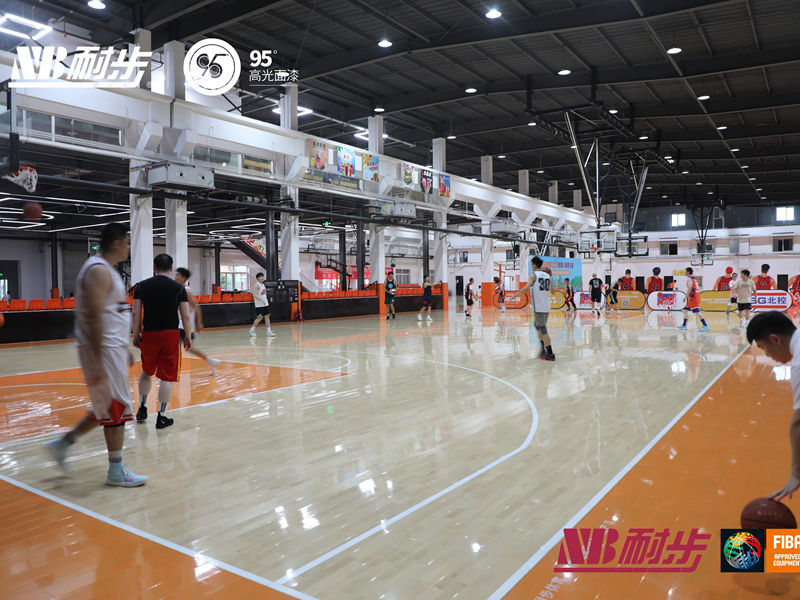
There are several distinct types of indoor sports wooden flooring systems, each designed for specific sports, performance levels, and installation contexts. Understanding these differences is essential for making the right choice for any given facility.
The most common type is the floating floor system. In this configuration, the wood planks are not directly attached to the subfloor. Instead, they are laid over a layer of elastic pads or shock-absorbing mats that sit on top of the subfloor. This design allows the floor to move slightly under load, providing excellent shock absorption and vibration reduction. Floating systems are widely used in basketball courts, volleyball courts, and multi-purpose gyms. They are also the easiest to install and the most forgiving in terms of subfloor imperfections.
The second type is the fixed or nailed-down system. Here, the wood planks are mechanically fastened directly to the subfloor using nails, screws, or adhesive. This creates a very rigid, stable surface with minimal movement. Fixed systems are typically used in areas where maximum ball rebound and energy return are required, such as professional basketball courts. The trade-off is that fixed floors transmit more impact to the athlete's joints, so they are often paired with additional underlayment for shock absorption.
A third type is the combined system, which uses elements of both floating and fixed designs. For example, the perimeter of the court may be nailed down for stability, while the central playing area floats on elastic pads for shock absorption. This hybrid approach is common in high-level competition venues where both performance and athlete safety are top priorities.
There are also differences in plank construction. Solid hardwood planks are made from a single piece of wood and offer the best performance and feel, but they are more expensive and more sensitive to moisture. Engineered hardwood planks consist of a thin layer of hardwood on top of a plywood or HDF core. They are more dimensionally stable and less prone to warping, making them a popular choice for facilities in climates with fluctuating humidity.
Plank width and thickness also vary. Basketball courts typically use wider planks (around 70mm) for a more seamless appearance, while badminton courts often use narrower planks for better visual line clarity. Thickness usually ranges from 20mm to 26mm for most sports applications.
Choosing the right type of indoor sports wooden flooring system requires balancing performance needs, budget, installation conditions, and the specific sports being played. There is no one-size-fits-all solution — the best system is the one that matches the facility's requirements.
Leave a Reply