

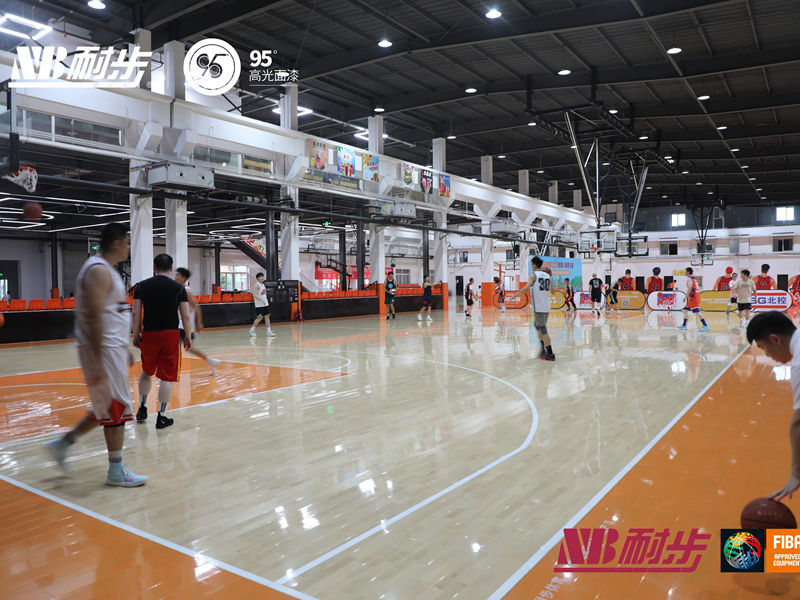
The decision to invest in portable indoor basketball court wooden flooring comes with a long list of advantages that make it increasingly popular across a wide range of settings. Understanding these benefits helps buyers make informed choices and helps facility managers justify the expenditure.
The most obvious advantage is mobility. A portable court can be set up in a multipurpose gymnasium on Monday for basketball, rolled away on Tuesday to make room for volleyball, and redeployed on Wednesday for a community event. This versatility is impossible with permanent hardwood floors, which occupy the space permanently. For schools with limited gym time, this means more sports can be accommodated in the same physical footprint.
Cost efficiency is another major advantage. Permanent hardwood basketball court installation typically costs between fifteen and thirty dollars per square foot when you factor in subfloor preparation, hardwood material, finishing, and labor. A portable system costs significantly less upfront, often ranging from eight to twenty dollars per square foot depending on quality. More importantly, the reusability means the cost per use drops dramatically over time. A portable court that is used for five years and moved three times has an effective cost per use that is a fraction of a permanent installation.
Installation speed is remarkable. A full-size portable basketball court can be assembled by a small team in as little as four to eight hours. There is no need for sanding, staining, or curing time. The panels simply unroll or click into place. This means a school can have a basketball court ready for the first day of practice without weeks of construction disruption.
Maintenance is simplified compared to permanent hardwood. Portable systems do not require refinishing, which is one of the most expensive and disruptive aspects of permanent court ownership. When the surface gets scratched or worn, individual panels or tiles can be replaced without touching the rest of the court. Cleaning is also easier — most portable systems are designed to be swept or mopped without special care, and many are compatible with standard gym cleaning equipment.
Portability also opens up opportunities for revenue. Event venues can rent out portable basketball courts for tournaments, corporate events, or exhibitions. Community centers can host pay-to-play leagues on courts that would otherwise sit unused. The ability to move the court means the same investment can serve multiple locations, effectively multiplying its value.
From a safety perspective, portable wooden flooring often includes built-in shock absorption that exceeds what you get with bare permanent hardwood. This reduces the risk of joint injuries, particularly for younger players or those playing recreationally. The consistent surface also reduces the chance of ankle rolls that can occur on uneven or poorly maintained permanent courts.
Finally, there is the advantage of future-proofing. If a facility is renovated, expanded, or repurposed, a portable court can be moved to a new location within the building or even to a completely different building. A permanent court cannot do this. In an era where space usage is constantly evolving, this flexibility is not a luxury — it is a necessity.
Leave a Reply