

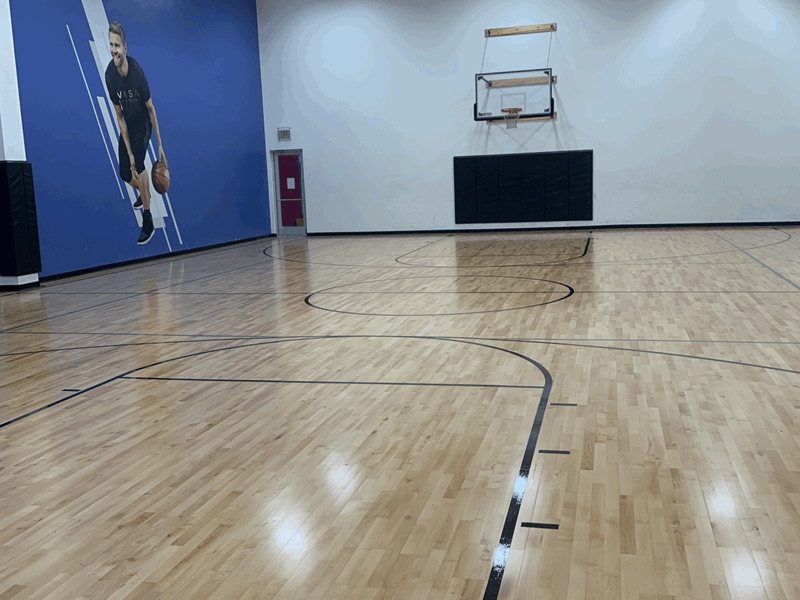
To truly understand why indoor sports wooden flooring performs the way it does, it helps to look at it as a system of layers, each with a specific function. Much like a high-performance athletic shoe, where every component is designed for a purpose, every layer of a sports wood floor contributes to the overall performance of the playing surface. Let us break it down from top to bottom.
The topmost layer is the wearing surface, and this is where the magic happens. This layer is made from premium hardwood — almost always hard maple, though oak and ash are also used in some applications. The hardwood is typically 18 to 22 millimeters thick and is milled to precise tolerances to ensure a perfectly flat surface. The wood is selected for its density, hardness, and grain consistency. In professional sports floors, the wood is often graded to ensure that only the highest-quality boards are used on the playing surface.
The finish coat is applied directly to the hardwood surface. This is typically a water-based polyurethane, applied in 8 to 12 coats, with light sanding between each coat. The finish serves multiple purposes: it protects the wood from moisture and abrasion, it provides the necessary traction for athletic movements, and it gives the floor its characteristic sheen. The number of coats and the type of finish are carefully calibrated to achieve the right balance of grip and smoothness.
Below the hardwood layer is the elastic layer, which is the heart of the shock absorption system. This layer is made from materials such as natural rubber, synthetic rubber, polyurethane foam, or a combination of these. The thickness of this layer can range from 5 millimeters to 15 millimeters, depending on the required performance specifications. This layer is what allows the floor to deform under load and then return to its original shape, absorbing the energy that would otherwise be transmitted to the athlete's body.
Some high-performance sports wood floors use a double-elastic system, with two layers of shock-absorbing material separated by a thin plywood layer. This design provides even better shock absorption and more consistent performance across the entire surface.
The sub-floor layer is typically made from birch plywood, usually 9 to 12 millimeters thick. This layer provides the structural stability for the entire system. The plywood is laid in a cross-grain pattern, with the grain of each panel running perpendicular to the adjacent panels. This cross-grain construction minimizes dimensional movement and ensures that the floor remains flat and stable over time.
Between the sub-floor and the concrete slab, you will often find a moisture barrier. This is a polyethylene sheet, typically 6 to 10 mil thick, that prevents moisture from the concrete from migrating up into the wood. Moisture is the number one enemy of wood flooring, and this barrier is essential for long-term performance.
In some installations, a foam underlayment is placed between the moisture barrier and the plywood sub-floor. This underlayment provides an additional layer of sound insulation and minor shock absorption, and it also helps to level out any small imperfections in the concrete slab.
The bottom-most layer is the concrete slab itself, which serves as the foundation for the entire system. The concrete must be flat, strong, dry, and free of cracks. Any deficiencies in the concrete will be transmitted through to the playing surface, so it is critical that the slab meets the required specifications before installation begins.
Understanding this layer-by-layer construction helps explain why indoor sports wooden flooring is so effective. Each layer works in harmony with the others to create a playing surface that is flat, responsive, shock-absorbing, and durable. It is a testament to the ingenuity of flooring engineers who have spent decades perfecting this system.
Leave a Reply