

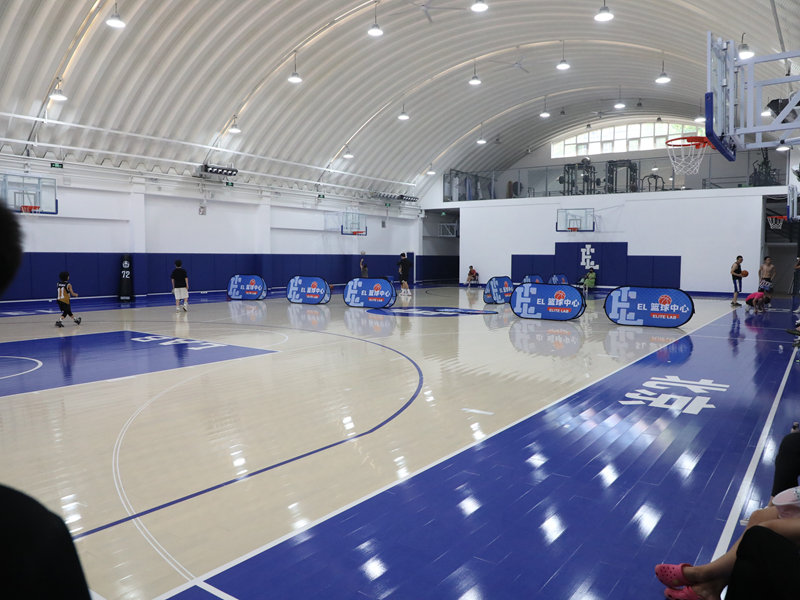
Not all indoor sports are created equal, and neither are the flooring requirements for each sport. While indoor sports wooden flooring is a versatile product, the specific specifications — including thickness, shock absorption, ball bounce, and surface finish — must be tailored to the demands of each sport. Choosing the wrong floor for your sport can lead to poor performance, increased injury risk, and a frustrating experience for athletes. Let us explore the ideal flooring specifications for the most popular indoor sports.
Basketball is perhaps the most demanding sport in terms of flooring requirements. The floor must provide excellent ball bounce (a basketball dropped from 1.8 meters should bounce back to 1.2–1.4 meters), high shock absorption (vertical deformation of 2.3–5.3 millimeters), and exceptional traction for quick stops, starts, and directional changes. The ideal indoor sports wooden flooring for basketball is 22 to 26 millimeters thick, with a hardwood surface of hard maple at least 20 millimeters thick. The finish should be matte to reduce glare under arena lighting.
Volleyball places different demands on the floor. The primary concern is shock absorption, as volleyball players are constantly jumping and landing. The floor should provide a vertical deformation of at least 2.3 millimeters to protect the players' knees and ankles. Ball bounce is less critical for volleyball than for basketball, but the surface still needs to be flat and consistent. A thickness of 20 to 24 millimeters is typically sufficient for volleyball courts.
Badminton and table tennis require a very different type of flooring. These sports involve rapid lateral movements and require a surface that is extremely flat (with a maximum deviation of 1 millimeter over any 2-meter span) and has minimal friction. The ball bounce is not a factor, but traction is critical. The floor should be thin — typically 18 to 20 millimeters — with a very smooth, matte finish. Hard maple is the preferred wood species for these sports.
Handball is similar to basketball in many ways, with high demands on ball bounce and shock absorption. However, handball players also slide frequently, so the surface must provide good traction even when wet with sweat. A floor thickness of 22 to 26 millimeters with a semi-gloss finish is typically recommended.
Futsal (indoor soccer) requires a floor with good shock absorption and excellent ball control. The surface should not be too slippery, as players need to be able to change direction quickly. A thickness of 20 to 24 millimeters with a matte finish is ideal.
Gymnastics requires a floor with extremely high shock absorption to protect athletes from the impact of landings. The vertical deformation should be at least 5.3 millimeters, and the floor should be at least 24 millimeters thick. The surface should also be non-slip, even when chalk is present.
Multi-sport facilities present a unique challenge. If the facility will host multiple sports, the flooring must meet the most stringent requirements of all the sports that will be played. This typically means designing the floor to meet basketball specifications, which are generally the most demanding.
In all cases, the quality of the installation is just as important as the specifications of the floor itself. Even the best flooring will perform poorly if it is not installed correctly. Always work with experienced professionals who understand the specific requirements of your sport.
Leave a Reply