

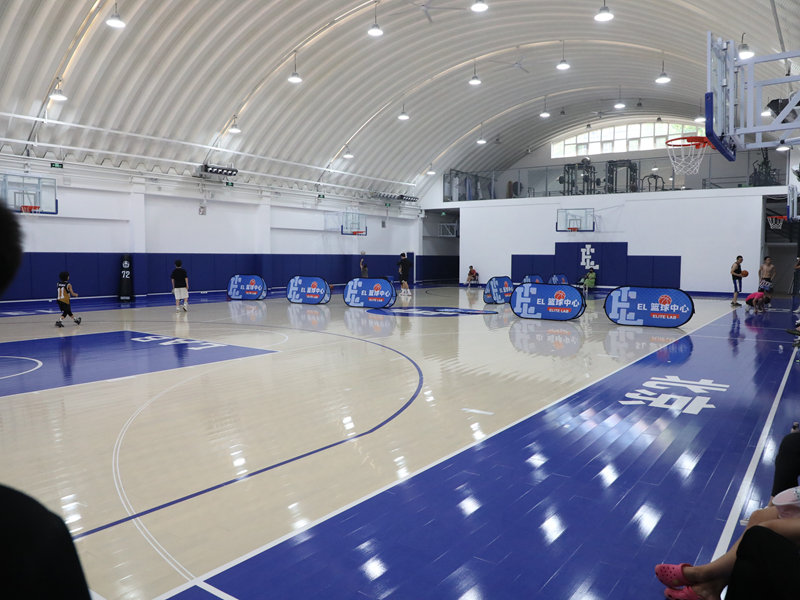
Basketball court wood flooring offers a range of acoustic benefits that greatly improve the overall experience of everyone in an indoor sports facility, from players and coaches to spectators and facility staff. Indoor basketball spaces are naturally very loud environments, with the sound of shoes squeaking, balls bouncing, voices echoing, and large crowds cheering. Without proper acoustic management, these sounds can bounce off hard walls and ceilings to create a harsh, overwhelming echo that makes communication difficult and makes the space feel far more chaotic than it needs to be. The natural properties of wood help to absorb and diffuse sound in ways that create a much more balanced, pleasant acoustic environment.
When sound waves travel through an indoor space, they interact with every surface they encounter. Hard, non-porous surfaces like concrete, tile, or solid synthetic flooring reflect almost all sound energy directly back into the room, creating long reverberation times where every noise echoes and overlaps with the next. This makes it hard for players to hear their coaches’ instructions, for referees to communicate calls clearly, and for spectators to follow the action without being overwhelmed by constant noise. Basketball court wood flooring, by contrast, is a porous, layered system that absorbs a significant amount of sound energy when sound waves hit it, rather than reflecting all of it back. This reduces the overall reverberation in the space, making every sound feel clearer and less distorted.
The layered structure of a modern wood court system also helps to reduce the transmission of impact noise through the floor structure. The sound of hundreds of feet running and jumping on the court can create loud, low-frequency vibrations that travel through the floor slab and into spaces located below the basketball court. This is a major problem in multi-use facilities that have classrooms, offices, or other activity spaces located on lower levels, as the constant thud of footsteps can be extremely disruptive for people in those areas. The resilient underlayment layers that are part of a quality basketball court wood flooring system act as a natural sound dampener, absorbing these impact vibrations before they can travel down into the building structure, greatly reducing noise pollution for people in other parts of the facility.
The warm, natural sound characteristics of a wood court also change the way the game itself sounds to everyone in the space. The bounce of a basketball on a well-maintained wood floor has a distinct, clear, resonant sound that feels satisfying and connected to the game, rather than the dull, muffled thud that a ball makes on some synthetic surfaces. The familiar sound of shoes squeaking gently across the wood becomes a classic part of the basketball experience, rather than a harsh, shrill noise that cuts through the air. These subtle acoustic details create a more immersive, enjoyable atmosphere that makes playing and watching basketball feel more like a special, intentional experience.
Even for facilities that host multiple sports and events, the acoustic performance of basketball court wood flooring creates a more versatile space that works well for everything from volleyball games and gymnastics meets to community events and assemblies. The reduced echo makes public speaking easier, music sounds better, and every activity feels more comfortable for the people participating. This underdiscussed benefit of wood flooring is one of the reasons that so many multi-purpose indoor facilities choose to invest in a wood court system, as it improves the experience of every single activity that takes place on the surface.
Leave a Reply