

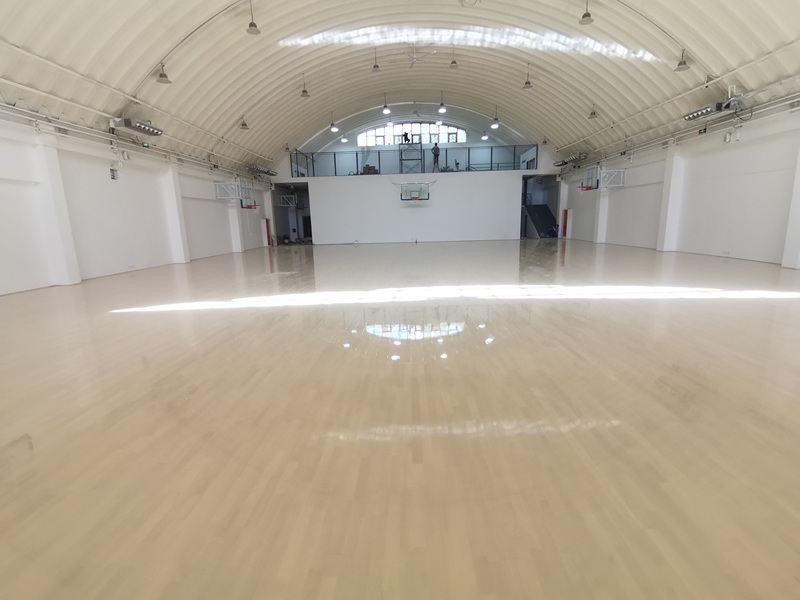
A floor that's not perfectly flat creates unpredictable ball behavior and foot placement. This is particularly dangerous for:
- Landing injuries: If one foot hits a high spot and the other a low spot during a jump landing, the legs absorb uneven forces → ACL tear risk increases dramatically.
- Ankle sprains: A 2mm bump can roll an ankle that a flat surface wouldn't.
- Trips: Gaps or lips between panels catch toes.
Standards require ≤2mm deviation over 2m. Professional facilities often specify ≤1mm. This level of flatness is achievable with quality wood flooring but requires skilled installation.
The Role of Surface Temperature
Cold floors increase injury risk:
- Cold muscles are less flexible and more prone to strain
- Cold surfaces reduce friction (rubber soles harden in cold)
- Players unconsciously reduce activity on cold floors, altering movement patterns
- Binder systems (polyurethane) create more durable pads
- Performance: 80-90% of virgin rubber at 40-60% of the cost
Natural Fiber Composites:
- Hemp, flax, or jute fibers combined with bio-based resins
- Provide moderate shock absorption (15-25%)
- Fully biodegradable at end of life
- Carbon-negative (plants absorb CO₂ during growth)
- Currently suitable for training/recreation floors; professional applications in development
Cork Composites:
- Cork is naturally resilient, lightweight, and sustainable
- Agglomerated cork panels provide 10-20% shock absorption
- Excellent acoustic properties
- Antimicrobial properties
- Best for multi-purpose and dance floors
Mycelium-Based Materials (Emerging):
- Grown from fungal networks on agricultural waste
- Naturally forms a resilient, lightweight structure
- Fully compostable
- Currently in R&D — early prototypes show 15-25% shock absorption
- Could revolutionize sustainable sports flooring in 5-10 years
Technology 4: Smart Subfloor Systems
The frontier of sports flooring is the "smart floor" — a subfloor embedded with sensors and connectivity:
Embedded Sensor Arrays:
- Pressure sensors measure player load distribution in real time
- Accelerometers detect impact forces and landing quality
- Temperature and humidity sensors monitor subfloor conditions
--150/m² installed - Lifespan: 20-30 years (refinishable)
- Superior aesthetics, better acoustics, more "alive" feel
- Requires more careful maintenance
Leave a Reply