

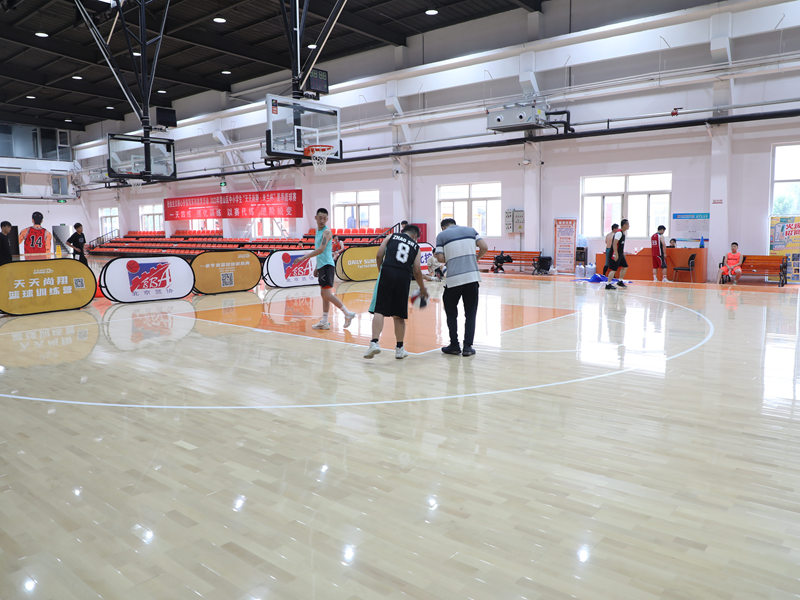
Professional dancers overwhelmingly prefer hardwood:
- Feel: Wood has a "living" quality — it responds to the dancer, has subtle give, and feels connected
- Sound: Wood produces a warm, musical sound when danced on — part of the performance
- Temperature: Wood is warmer than vinyl (which can feel cold and plastic)
- Aesthetics: Beautiful wood elevates the space — important for companies that tour and perform
- Durability: Wood lasts longer and can be refinished — vinyl must be replaced
Cushion Systems for Dance
Dance requires a different cushion profile than sports:
| System | Thickness | SA | Feel | Best For |
|---|---|---|---|---|
| Thin PU foam | 3-4mm | 15-25% | Firm, responsive | Ballet, contemporary |
| Medium rubber | 5-8mm | 25-35% | Balanced | Multi-genre |
| Thick foam + rubber | 8-12mm | 30-40% | Soft, forgiving | Hip-hop, floor work |
| Cork composite | 6-10mm | 20-30% | Warm, natural | Contemporary, modern |
The key for dance: the cushion should feel "responsive" — it absorbs impact but returns energy quickly. Dancers don't want to sink; they want to bounce. This is different from basketball, where maximum absorption is desired.
Special Considerations for Dance Floors
- Sprung Floors: Professional dance companies often use fully sprung systems — mechanical springs under the subfloor that provide 40-5
- Logo Center Court: Large team/school logo at center court in contrasting colors.
- Creative Patterns: Geometric designs, gradient fades, or artistic patterns. Popular in community centers and schools.
- Multi-Sport Zones: Different colors for different sports within the same facility (e.g., blue for basketball, green for volleyball).
Critical Note on Painted Floors and Friction:
Paint adds a layer on top of the finish, which can significantly alter friction. A floor that measured COF 0.55 with clear finish might measure 0.35 with paint — dangerously slippery.
Solution: Use specialized sports floor paint with friction additive, or apply a non-slip topcoat over the paint. Test COF after painting — it's mandatory.
Inlaid Wood: The Premium Aesthetic
The most beautiful and durable decorative option is wood inlay — using contrasting wood species to create patterns, logos, and lines.
Common Inlay Combinations:
- Maple + Birch (subtle contrast)
- Maple + Walnut (dramatic contrast)
- Maple + Cherry (warm contrast)
- Maple + Wenge (very dark, modern look)
- Maple + Padauk (reddish, exotic look)
Process:
- CNC-cut the pattern from contrasting wood
- Inlay into the maple surface during manufacturing (pre-finished) or on-site
- Sand flush with surface
- Apply finish over entire surface (seamless)
**Ad — wood-on-wood is stunning
- Maintains friction (no slippery coating)
- Can be refinished with the surface
Disadvantages:
- Expensive (CNC cutting, skilled labor)
- Limited to geometric patterns (curves are difficult)
- Requires precise manufacturing
Cost: $15-40/m² additional for inlay work
Surface Finish Effects on Appearance
The finish (polyurethane, oil, wax) dramatically affects the floor's look:
| Finish | Gloss Level | Appearance | Grain Visibility | Maintenance |
|---|---|---|---|---|
| High-gloss PU | 60-80 GU | Shiny, "wet" look | Moderate | Easy |
| Satin PU | 30-50 GU | Natural, warm | High | Easy |
| Matte PU | 10-25 GU | Flat, modern | Very high | Moderate |
| Oil finish | 10-20 GU | Natural, hand-rubbed | Very high | Frequent |
| Wax | 5-15 GU | Soft, vintage | High | Frequent |
For sports floors, satin to matte is preferred — high gloss is slippery when wet with sweat and looks too "showy" for athletic use.
Leave a Reply