

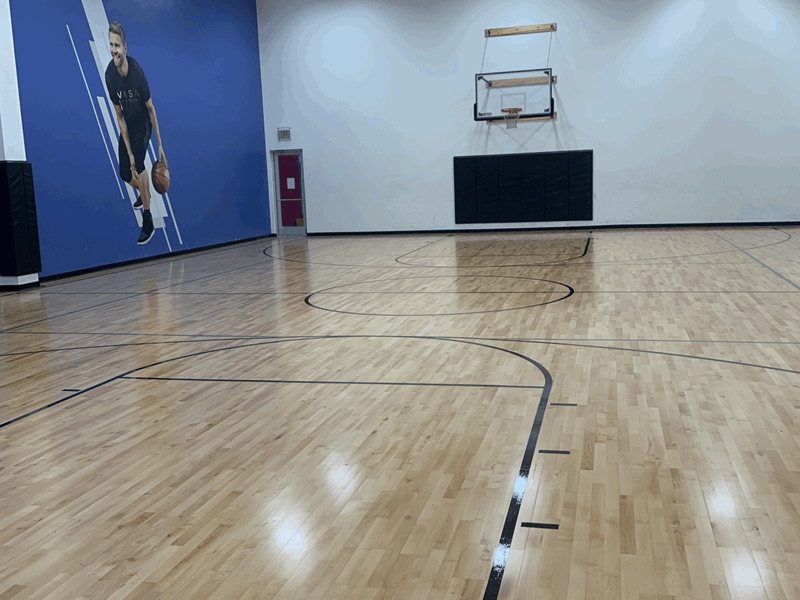
Volleyball floors cost 10-20% more than equivalent basketball floors due to:
- Higher friction finish (specialty formulation)
- Slightly thicker surface (24mm vs. 22mm typical)
- More frequent maintenance/recoating
- Stricter flatness requirements (volleyball is more sensitive to surface irregularities)
Common Volleyball Floor Problems
| Problem | Cause | Solution |
|---|---|---|
| Too slippery when wet | Finish worn, insufficient friction additive | Recoat with friction-enhanced finish |
| Players sliding too far | Excessive friction OR too much shock absorption | Reduce friction additive; check SA levels |
| Knee pain complaints | Insufficient shock absorption | Add more rubber padding |
| Ball behavior inconsistent | Uneven finish or subfloor | Sand and recoat; check subfloor flatness |
| Visible slide marks | Herringbone shoe sole abrasion | Accept as normal; recoat when excessive |
Conclusion
A volleyball court floor must balance high friction for sliding control with adequate shock absorption for jump landing protection — while maintaining excellent ball behavior and visual appeal. It's a nuanced engineering challenge that
- Loose-fill rubber: Poured into cavity, compacted (rare in sports)
Critical installation rules:
- Cushion must cover 100% of the subfloor (no gaps — gaps create hard spots)
- Overlap seams by 100mm minimum
- Don't compress during installation (compressed rubber loses performance)
- Maintain expansion gaps at perimeter (cushion compresses, needs room)
Testing and Verification
Every cushion system should be tested as part of the complete floor assembly (not just the cushion alone):
- Shock absorption: EN 14904 or ASTM F355 — measured with the hardwood surface installed
- Ball rebound: EN 14904 — must be tested with the actual ball and surface
- Vertical deformation: EN 14904 — ensures the floor doesn't deflect too much
- Dynamic stiffness: Measures how the cushion responds to repeated impacts (simulates game play)
Beware of manufacturers who test cushion materials in isolation. A rubber pad that tests at 30% shock absorption might only deliver 20% when installed under a hardwood floor with plywood subfloor — the wood and plywood also contribute to the system.
Long-Term Performance and Maintenance
Cushion systems degrade over time. The rate depends on material:
| Material | Expected Performance Life | Degradation Mode |
|---|---|---|
| Natural rubber | 20-30 years | Gradual hardening |
| Synthetic rubber | 15-25 years | Compression set |
| Recycled rubber | 10-20 years | Permanent compression |
| PU foam | 5-10 years | Creep (permanent compression) |
| Honeycomb | 25+ years | Minimal (geometric) |
Signs of cushion degradation:
- Floor feels harder than when
| Species | Tangential Movement | Radial Movement | Stability Rating |
|---|---|---|---|
| Hard Maple | 0.16%/%MC | 0.08%/%MC | ⭐⭐⭐⭐ Good |
| Red Oak | 0.18%/%MC | 0.09%/%MC | ⭐⭐⭐ Moderate |
| White Ash | 0.19%/%MC | 0.10%/%MC | ⭐⭐⭐ Moderate |
| European Beech | 0.17%/%MC | 0.08%/%MC | ⭐⭐⭐⭐ Good |
| Birch (plywood) | 0.14%/%MC | 0.07%/%MC | ⭐⭐⭐⭐⭐ Excellent |
Note: Birch plywood is used for subfloor panels because its cross-grain construction (alternating grain direction in each ply) dramatically reduces movement. A well-made birch plywood panel moves 5-10x less than solid wood in the same conditions.
The Role of Finish in Movement
The surface finish acts as a moisture barrier — but only on the top surface. A good polyurethane finish slows moisture exchange through the top face by 50-80%. This means:
- The top face changes MC more slowly than the bottom
- This can actually INCREASE cupping risk if the bottom gets wet (differential is greater)
- Solution: Always use a vapor barrier on the bottom, regardless of finish quality
Thinner finishes (3-4 coats) allow more moisture exchange and reduce differential. Thicker finishes (7-8 coats) create a stronger barrier on top, increasing differential risk.
Quarter-Sawn vs. Flat-Sawn Lumber
This is a critical specification for sports flooring:
- Flat-sawn (plain sawn): Growth rings at 0-30° to face. More movement, more prone to cupping. Cheaper.
- Quarter-sawn: Growth rings at 60-90°
- Health Costs: Studies suggest that harder synthetic surfaces may contribute to higher rates of overuse injuries. While difficult to quantify, even a small increase in injury rates (1-2% more) translates to significant medical costs for a busy facility.
The Value of Refinishing
This is wood's superpower. When a wood floor's surface wears out, you don't replace the entire floor — you sand it down 1-2mm and apply a new finish. The structural wood is as good as new.
- Cost of refinishing: 6−12/m2(vs.80-150/m² for full replacement)
- Frequency: Every 8-12 years
- Number of times: 3-6 over a 30-year lifespan
- Total refinishing cost: $18-72/m² over 30 years
No synthetic floor offers this capability. Once the surface is gone, the whole floor goes.
Financing and Budgeting Implications
For capital budgeting, the difference matters:
| Wood | Synthetic | |
|---|---|---|
| Year 0 Capital Outlay | $75,000 | $45,000 |
| Annual Operating Budget | $3,000 | $2,000 |
| Major Capital Event | $15,000 (yr 10) | $50,000 (yr 12) |
| 10-Year Total | $120,000 | $115,000 |
| 20-Year Total | $165,000 | $155,000 |
| 30-Year Total | $210,000 | $235,000 |
In the short term (5-10 years), synthetic appears cheaper. But beyond 15 years, wood pulls ahead. For facilities with long planning horizons (schools, universities, municipal facilities), wood is the clear winner.
**The Foot "locks" to floor during rotation
- Knee absorbs rotational force → ACL tear
- Ankle absorbs rotational force → severe sprains
- Increased abrasion injuries (skin, shoes)
The Sweet Spot:
| Sport | Optimal COF | Injury Risk at Low COF | Injury Risk at High COF |
|---|---|---|---|
| Basketball | 0.4-0.55 | 2.3x ankle sprains | 1.8x knee injuries |
| Volleyball | 0.5-0.65 | 2.1x knee injuries | 1.5x ankle sprains |
| Handball | 0.45-0.60 | 1.9x ankle sprains | 1.6x knee injuries |
| Badminton | 0.4-0.50 | 1.5x ankle sprains | 1.3x knee injuries |
Leave a Reply